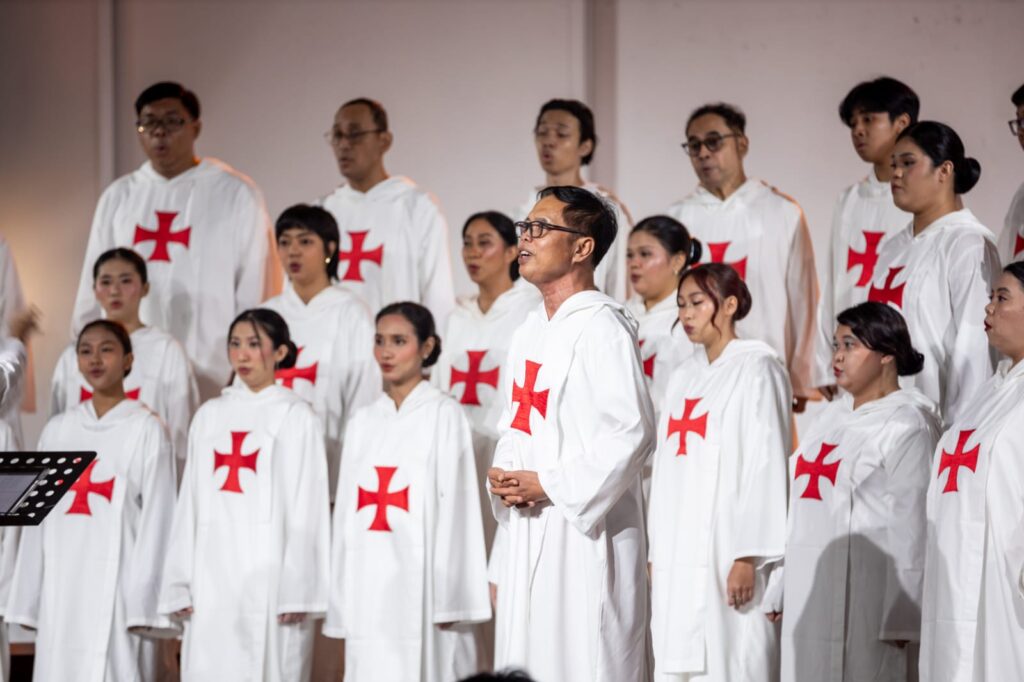


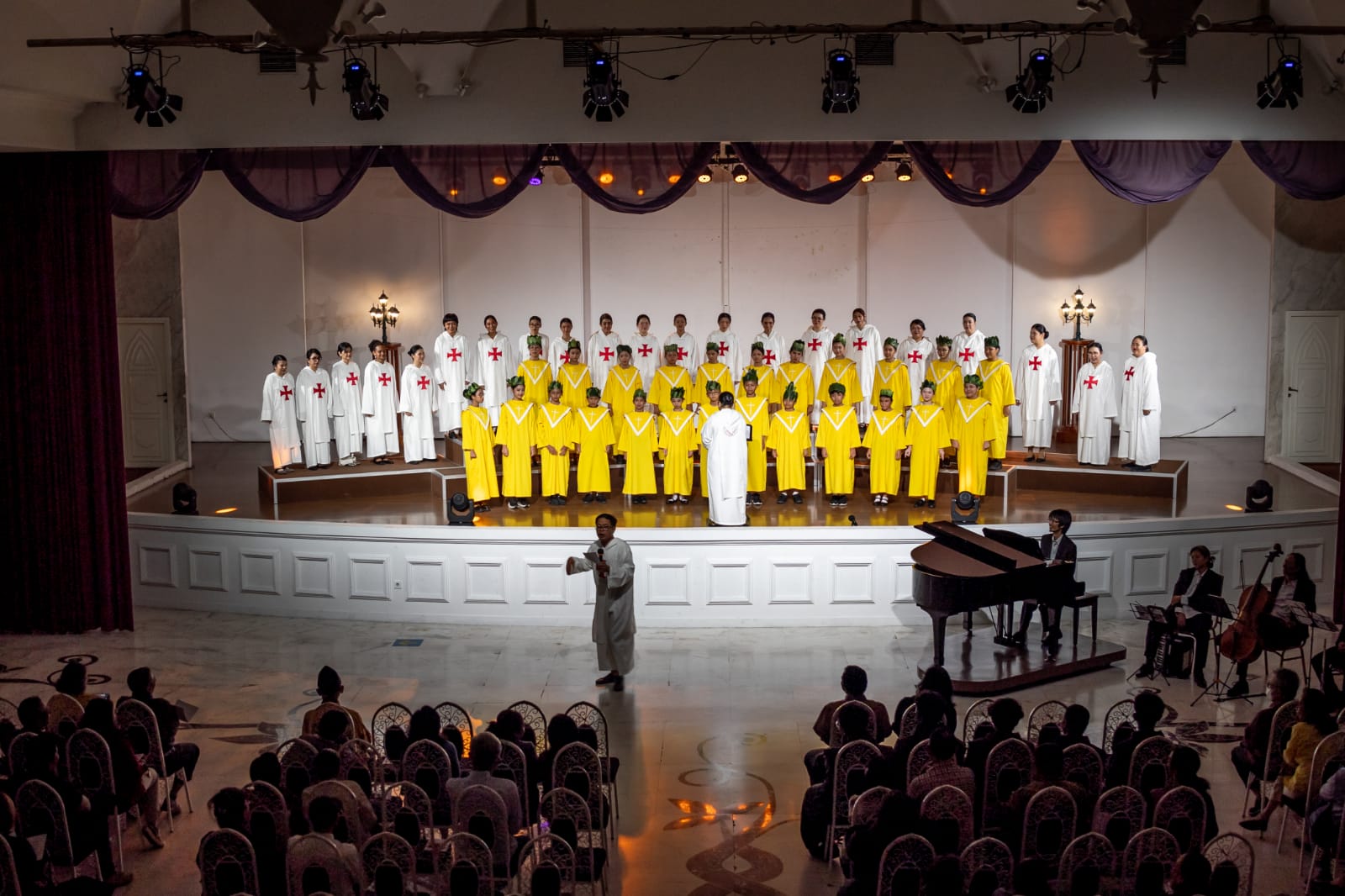
Through sacred music, spiritual reflection and a message of environmental care, Cantica Sacra Choir and Cantica Sacra Children Choir invite audiences to see ecological conversion as a call of faith to care for the Earth, our common home and the home of all creation.
JAKARTA – The twilight atmosphere at Graha Swara, Tarumanagara University, Jakarta, on Sunday (22 November 2026), provided a setting for an encounter between music, spirituality and environmental concern. Through the Twilight Concert Laudato Si’, Cantica Sacra Choir (CSC) and Cantica Sacra Children Choir (CSCC) presented a musical performance inviting audiences to reflect on humanity’s journey towards caring for the Earth as our common home.
Held from 5 p.m. to 8 p.m. local time, the concert drew inspiration from Laudato Si’, the encyclical issued by Pope Francis in 2015. The document calls for ecological conversion and urges humanity to develop a deeper awareness of the need to protect the environment and respect all creation.
The performance also drew on the spirituality of St Francis of Assisi, known for his profound love of the natural world. For St Francis, the sun, moon, wind, water and all living creatures belong to one great family of God’s creation.
Through 17 liturgical, religious and patriotic musical selections, the concert unfolded as a musical journey tracing the beauty of creation, the destruction of nature caused by human actions, and the awakening of a renewed commitment to repentance and hope for the Earth.
Music as a Dramatic Journey Towards Ecological Conversion
The concert’s artistic director, Jay Wijayanto, arranged the repertoire into a dramatic narrative of ecological conversion. Each piece was carefully placed within a broader story about the Earth and humanity’s responsibility for sustaining life.
The concert opened with All Things Bright and Beautiful, performed by Cantica Sacra Choir. With music by John Rutter, the song celebrates the beauty of the world and everything in it as God’s creation, inviting people to respond with gratitude.
A message of peace followed with Let There Be Peace on Earth, performed by Cantica Sacra Children Choir. The song reminds audiences that everyone, including children, is called to become a peacemaker.
Gratitude for the beauty of nature continued through Betapa Tidak Kita Bersyukur, There Will Come Soft Rains and The Rose. Together, the pieces offered reflections on the beauty of nature, rain, flowers and life itself as gifts to be cherished and protected.
Yet the musical journey did not remain with the beauty of creation. It led audiences to confront the reality of environmental destruction driven by human greed, the exploitation of natural resources, pollution and the devastation caused by war.
This darker reality was expressed through O Sacred Head, Now Wounded. Within the concert’s dramatic framework, the wounds of Christ depicted in the hymn became a symbol of the suffering inflicted on the Earth by humanity’s ecological sins.
Repentance as a Path to Healing
After confronting the wounds and destruction suffered by the Earth, the concert moved towards a message of repentance and hope.
The Prayer of Saint Francis called on humanity to become instruments of peace, light, truth and hope in a wounded world. Meanwhile, O for the Wings of a Dove expressed the human struggle that arises when people are confronted with the responsibility to change.
The concert’s reflection on repentance reached its high point with Miserere Mei Deus by Gregorio Allegri. This sacred composition from the Baroque period is widely known as an expression of remorse and a plea for mercy. In the context of the concert, it symbolised humanity’s willingness to acknowledge its failures and repent for actions that have harmed the Earth.
Hope for healing emerged through Fratello Sole Sorella Luna, a piece rooted in the spirituality of St Francis of Assisi. The call to love and care for the Earth was reinforced by Indonesia Bumi Persada, composed by Binsar Sitompul.
Cantica Sacra Children Choir brought a gentler atmosphere to the programme with Belaian Sayang by Bing Slamet and Seal Lullaby by Eric Whitacre.
The concert concluded with Hallelujah by George Frideric Handel, expressing triumph, joy and the hope that change towards a better way of life remains possible.
Liturgical Music Education and Formation for Seminarians
Beyond offering an opportunity for ecological reflection, Twilight Concert Laudato Si’ also promoted the education and formation of Catholic liturgical musicians.
During the programme, Jay Wijayanto introduced audiences to the history of liturgical music in Indonesia and several figures who have made significant contributions to the development of music in the Church.
Those introduced included Father F.G.J. van Lith, SJ; Liberty Manik; Father Karl-Edmund Prier, SJ; Paul Widyawan; and Father A. Sutanto, SJ. Their contributions have helped shape the development of liturgical music, including through the works and publications of the Centre for Liturgical Music in Yogyakarta.
This educational mission is closely linked to the commitment of Yayasan Cantica Sacra Indonesia to developing liturgical music skills among seminarians.
Indonesia has 47 minor seminaries spread across five regions. Since 2025, the Cantica Sacra Foundation has been developing a music training programme for seminarians. Each participating seminary receives 100 hours of training through a series of workshops, with the skills acquired intended for practical use in Mass celebrations and concerts.
In 2027, Cantica Sacra plans to provide in-person training for five seminaries and prepare a compilation of music for the Sacred Paschal Triduum, with special arrangements for other seminaries.
The concert received support from the Seminary Commission of the Indonesian Bishops’ Conference (KWI), the Seminary Care Group (KPS), the Parents’ Foster Movement for Seminaries (GOTAUS), and the Paguyuban Gembala Utama (PGU).
Around 300 people attended the concert, including priests, seminarians and Catholic faithful from the Archdiocese of Jakarta and the Diocese of Bogor. Several liturgical music practitioners actively involved in parish ministries were also present.
The two choirs performed with the support of several musicians, including Teodore Ignatius Minaroy on piano, Rhenaldi Wicaksono on flute, Windy Setiadi on accordion and Billy Aryo on cello. Mikha Ogung Panggabean also contributed to the training process and served as a conductor alongside the other conductors.
Through Twilight Concert Laudato Si’, Cantica Sacra conveyed a message that caring for the Earth is not merely an environmental concern but also an expression of responsibility rooted in faith.
Ecological conversion begins with personal awareness, takes shape through changes in attitudes and is carried forward through concrete action.
At the concert, music became a universal language connecting artistic beauty, spiritual depth and humanity’s responsibility towards all of God’s creation.