

YOGYAKARTA — Humanity is entering a new era where the world’s greatest powers are no longer defined solely by governments or military strength. Instead, they increasingly reside in technology corporations, political movements that thrive on division, and algorithms capable of influencing how people think, choose, and even understand themselves.
For Fr. Benedictus Hari Juliawan, SJ, the recently concluded Provincial of the Jesuits in Indonesia, these are not merely political or economic developments. They are profound spiritual challenges that call for a renewed vision of leadership rooted in faith, hope, and moral courage.
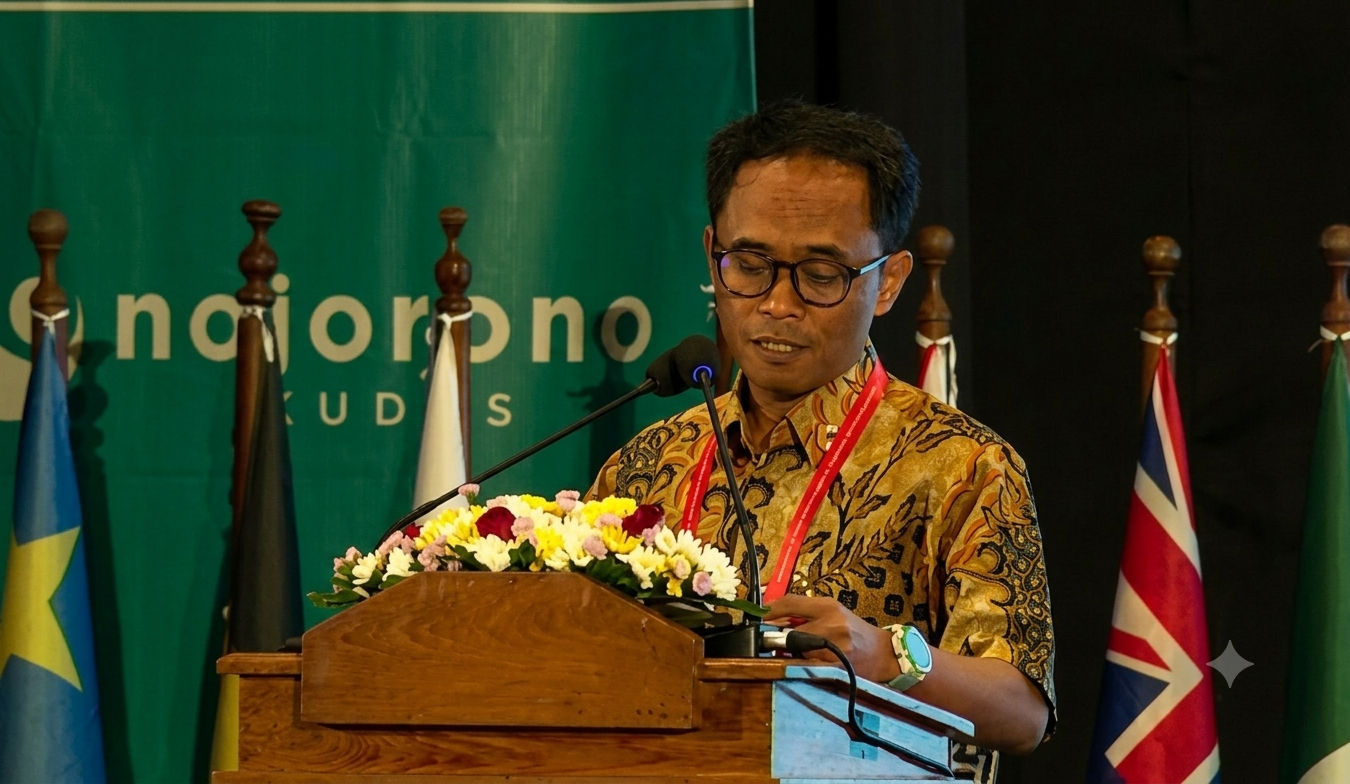
Speaking before delegates from more than 50 countries during the 11th World Union of Jesuit Alumni (WUJA XI) at Universitas Sanata Dharma in Yogyakarta on Friday (July 31), Fr. Benny challenged Jesuit alumni to rethink what Ignatian leadership means in an age of unprecedented global transformation.
With characteristic humor, he opened his presentation by saying that whenever one addresses an international audience, “you’ve got to use big words.” The two “big words” he chose were leadership and global—concepts that became the framework for a wide-ranging reflection on the world’s rapidly changing landscape and the Christian response it demands.
Three Forces Reshaping the World
According to Fr. Benny, today’s world is being transformed by three interconnected global forces unlike anything previous generations have experienced.
The first is the extraordinary rise of technology corporations.
Companies such as Meta, Microsoft, Amazon, Apple, Google, and Nvidia now command wealth greater than the gross domestic product of many medium-sized nations. Yet their influence extends far beyond economics. Unlike traditional multinational corporations that remain subject to territorial regulations, digital technology companies increasingly control information, communication, and public discourse across borders.
“They act almost like proto-sovereign entities,” Fr. Benny observed. They establish their own norms, operate according to their own territorial logic, and oversee populations composed not of citizens but of users.
Governments, he warned, are struggling to regulate these companies, while the corporations themselves wield unprecedented influence through their control of data and digital infrastructure.
The second force is what he called weaponized populism.
Although populism itself is not new, Fr. Benny argued that its resurgence has become increasingly disruptive to both domestic politics and international cooperation. Referring to the return of President Donald Trump to the White House, he noted that nationalist politics, anti-establishment rhetoric, and the concentration of power in strong leaders are once again reshaping global relations.
He pointed to the growing use of tariffs as political weapons, the erosion of traditional diplomacy, and the weakening of international consensus on issues such as climate change. Within societies themselves, political identities are increasingly exploited, while social media accelerates polarization and fragmentation.
“The fragmentation,” he suggested, “is no longer simply an unintended consequence. In many cases, it has become the desired outcome.”
The third and perhaps most unsettling force is what historian Yuval Noah Harari has described as the “hacking of human beings.”
Algorithms, Fr. Benny explained, increasingly understand individuals better than they understand themselves. Every search, purchase, movement, and interaction generates data that governments and corporations can use to influence human desires, decisions, and even democratic choices.
“We have surrendered control over our body and mind to external forces,” he warned.
The result is not merely a loss of privacy but something far deeper: humanity risks losing its capacity to govern imagination, exercise freedom, and discern the meaning of existence itself.
Against Despair: The Ignatian Conviction That People Can Change
Yet Fr. Benny refused to allow his audience to remain trapped in pessimism.
For Ignatian spirituality, every honest diagnosis of the world’s brokenness must ultimately lead to hope.
He posed what he considered a more important question than the centuries-old debate over whether human beings are fundamentally good or evil.
“Do you believe that people can change?”
For him, this question lies at the very heart of Ignatian leadership.
Drawing from the Spiritual Exercises of St. Ignatius of Loyola, Fr. Benny explained that Christianity begins by acknowledging human sinfulness but never ends there. God’s grace continually transforms the human person, inviting believers into the missio Dei—God’s mission in the world.
The Spiritual Exercises themselves illustrate this journey. They begin with an awareness of sin, continue through the transforming experience of God’s love, and culminate in the contemplation that enables believers to discover God’s loving presence in all things.
“The belief that people can change,” he said, “is the first thing that should happen.”
Recovering a Lost Moral Ambition
Hope alone, however, is not enough.
Fr. Benny argued that contemporary society suffers from another crisis that receives far less attention: the loss of moral ambition.
People readily acknowledge the scale of global problems but often convince themselves that meaningful change belongs only to governments, corporations, or powerful leaders.
He described this mindset as the NIMBY attitude—”Not In My Backyard.”
As long as problems appear distant, many prefer not to become involved.
Yet, he cautioned, politicians themselves increasingly lack ambitious visions capable of inspiring societies. Politics is reduced to solving immediate problems rather than imagining a better future.
Meanwhile, many of society’s brightest minds are drawn toward what he called the “Bermuda Triangle of Talent”—prestigious and highly paid careers in corporate consulting, finance, and law that often generate limited social benefit compared with their intellectual potential.
“People no longer have a moral ambition,” he lamented, “a desire to strive for something greater than themselves.”
For Ignatius of Loyola, he said, leadership begins precisely by refusing to surrender that larger vision.
Tradition recalls Ignatius gazing at the stars at night, finding there profound consolation and renewed desire to serve God.
“We should not let mundane concerns limit our vision,” Fr. Benny urged.
“Let’s be ambitious with our life. Let’s serve God with all our heart, our mind, and our strength.”
Great Change Begins with Small Acts
If Ignatian leadership requires bold vision, it also demands humble beginnings.
Fr. Benny acknowledged that this may sound paradoxical.
Real transformation, he explained, always starts with personal conversion before expanding into social renewal.
Using Pope Francis’ encyclical Laudato Si’ as an example, he described ecological conversion not as an abstract environmental policy but as a concrete change of habits.
Only after individuals reshape their own lifestyles can communities build consensus and eventually transform society itself.
He highlighted St. Francis of Assisi and St. Thérèse of Lisieux as complementary models for contemporary Christians.
St. Francis reminds believers of the forgotten value of voluntary simplicity within today’s consumer culture, while St. Thérèse teaches fidelity through ordinary daily gestures that reject violence, exploitation, and selfishness.
Such practices, Fr. Benny argued, help people regain mastery over imagination and desire—capacities increasingly weakened by consumerism and digital culture.
The challenge is learning to say “enough” in a world that constantly encourages unlimited consumption.
Drawing on philosopher Kate Soper’s concept of alternative hedonism, he suggested that genuine happiness lies not in endless accumulation but in relationships, intellectual growth, friendship, moderation, and the pursuit of a higher form of life.
Building a Culture of Care
Personal conversion ultimately points toward social transformation.
Echoing both Laudato Si’ and Pope Benedict XVI’s Caritas in Veritate, Fr. Benny argued that healthy societies are built upon gratuitous love rather than self-interest.
Authentic community grows when people give without expecting immediate return and cultivate relationships rooted in fraternity, mutual responsibility, and care for creation.
Such a culture, he said, cannot be imposed by governments alone. It is formed through countless acts of generosity and community engagement that restore broken relationships and strengthen the common good.
“Go, Set the World on Fire”
As his presentation drew to a close, Fr. Benny returned to the audience before him—Jesuit alumni gathered from around the world in the land where St. Francis Xavier once began his Asian missionary dream.
The WUJA Congress, he said, should become more than an international reunion.
It should rekindle the moral ambition that inspired Ignatius of Loyola, the First Companions, and generations of Jesuits and lay collaborators who believed that faith exists not simply to understand the world but to transform it.
Quoting the famous words attributed to St. Ignatius when sending St. Francis Xavier on mission, Fr. Benny concluded with a challenge that echoed throughout the auditorium:
“Ite, inflammate omnia”—Go, set the world on fire.