

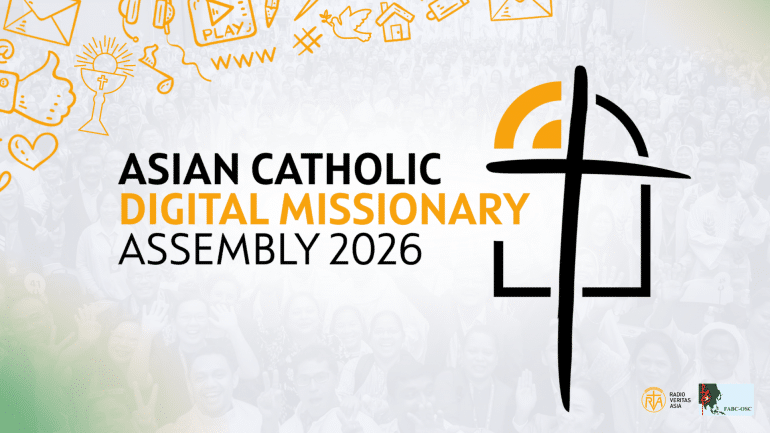
MANILA — Catholic digital missionaries, communicators, content creators, youth ministers, and faith influencers from across Asia are gathering in Manila for the first Asian Catholic Digital Missionary Assembly, seeking to chart a new path for evangelization in an increasingly digital continent.
The four-day assembly, held from September 10–13, 2026, at Radio Veritas Asia in Quezon City, brings together participants to reflect on how the Church can move beyond simply producing digital content toward becoming an authentic and credible witness of Christ in the digital world.
Organized by the Federation of Asian Bishops’ Conferences Office of Social Communication (FABC-OSC) and Radio Veritas Asia (RVA), in partnership with the Vatican Dicastery for Communication through the Fully Present Network, the gathering carries the theme “Influencers to Witnesses: A Synodal Way for Digital Mission in Asia.” The theme is inspired by Acts 4:20: “For we cannot but speak the things which we have seen and heard.”
The assembly is envisioned not merely as a conference, but as the beginning of a continental network of Catholic digital missionaries committed to evangelization, collaboration and mutual support.
From content creators to witnesses
The central question of the assembly is not simply how the Church can communicate more effectively online, but what kind of presence Catholic digital missionaries are called to become.
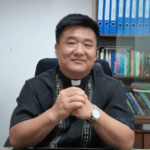
Fr. John Mi Shen, executive secretary of FABC-OSC and program director of RVA, said digital evangelization must begin with people rather than content.
“Before asking, ‘What should we communicate?’ we should ask, ‘What are people experiencing? What are they searching for?’” he said.
For Fr. Mi Shen, digital mission involves three essential movements: listen, accompany and witness.
A video, podcast, Bible reflection or social media post may open the door to an encounter, but the ultimate purpose should be to build relationships rather than simply increase views, followers or engagement.
“Behind every screen is a person who is looking for meaning, connection, and sometimes simply someone who will listen to them,” he said.
This perspective lies at the heart of the assembly’s effort to move Catholic digital communication from an emphasis on influence toward authentic Christian witness.
The distinction is particularly important in a digital culture where visibility and popularity are often measured by follower counts and engagement.
“An influencer normally asks, ‘How many people are following me?’ A witness asks, ‘Whom am I serving, and what am I witnessing to?’” Fr. Mi Shen said.
A synodal space for Asian voices
The assembly also reflects the diversity of the Asian Church.
Asia is home to different languages, cultures, religions and ecclesial experiences. The digital mission of the Church therefore cannot simply depend on translating the same message into different languages.
“Translation is important, but inculturation is deeper than translation,” Fr. Mi Shen said.
The assembly seeks to create a space where digital missionaries can listen to one another, share experiences from their respective countries, develop partnerships and discover new ways of communicating the Gospel within their own cultural contexts.
According to the organizers, the gathering is intended to amplify the diverse digital voices of Asian Catholics and strengthen the Church’s digital presence across the continent.
This approach is closely connected with RVA’s longstanding identity as the “Voice of Asian Christianity.” The organization began as a continental Catholic radio initiative and has since expanded into digital platforms, connecting audiences across Asia through multiple language services and social media platforms.
Digital mission as accompaniment
One of the assembly’s key concerns is how digital platforms can become spaces of genuine pastoral accompaniment.
Drawing on RVA’s experience, including its Mandarin Service and online Bible study initiatives, Fr. Mi Shen said digital platforms can reach people who may have limited opportunities to participate in parish activities, meet priests or join Bible studies in person.
Online Bible study, for example, can become more than the transmission of biblical information. Participants can read Scripture together, share personal experiences, ask questions and accompany one another in faith.
At the same time, digital ministry should not replace face-to-face pastoral ministry.
“Digital ministry is not a replacement for traditional pastoral ministry, but a complement and a bridge,” Fr. Mi Shen said.
The assembly therefore approaches the digital world not as a separate territory from the Church’s pastoral mission, but as another space where people live, search for meaning and seek relationships.
Building a continental network
One of the most significant goals of the Manila gathering is to move from individual digital initiatives toward a stronger regional network.
“This assembly is more than a conference. It is the beginning of a continental network of Catholic digital missionaries committed to evangelization, collaboration, and mutual support,” Fr. Mi Shen said.
The network is expected to encourage Catholic digital communicators to collaborate across national and cultural boundaries while supporting one another in their mission.
“Our goal is not simply to produce more digital content, but to form authentic witnesses of Christ who can communicate the Gospel with creativity, credibility, and compassion,” Fr. Mi Shen added.
The assembly also serves as a milestone in the Church’s preparation for World Youth Day 2027 in Seoul, South Korea. Participants are expected to explore the development of “Asian Voices for WYD,” a collaborative digital initiative intended to connect young Catholics across Asia ahead of the global gathering.
Credibility begins with life
The assembly’s emphasis on witnessing also raises a deeper question about credibility.
In a digital environment saturated with information, producing attractive content is no longer enough. The credibility of the message depends increasingly on the authenticity of the person behind it.
“If our digital presence is beautiful but our life does not reflect the Gospel, our message will eventually lose its credibility,” Fr. Mi Shen said.
For him, Catholic digital missionaries should not seek popularity as an end in itself.
“We should not try simply to become famous for Christ; we should try to make Christ known through our lives,” he said.
The challenge is therefore both digital and spiritual. The Church needs communicators who understand digital platforms, but also witnesses whose lives give credibility to what they communicate.
Bringing Christ into the digital peripheries
The Manila assembly comes at a time when digital platforms have become an important part of how people encounter information, communities, relationships and questions about faith.
The organizers hope the gathering will help the Church respond to this reality through a synodal approach—one characterized by listening, collaboration and shared mission.
For the participants, the task is not simply to become better influencers, but to become better witnesses.
Digital platforms may change, algorithms may shift, and new technologies may emerge. But the fundamental mission remains unchanged.
“Platforms will come and go,” Fr. Mi Shen said. “But the mission remains the same: to bring people closer to Christ and to build communion.”
The first Asian Catholic Digital Missionary Assembly thus seeks to establish a new understanding of digital mission in Asia: from followers to relationships, from content to encounter, and from influence to witness.
In the words of Acts 4:20, the mission begins with what the disciples themselves have seen and heard—and with their willingness to share that experience with others.