

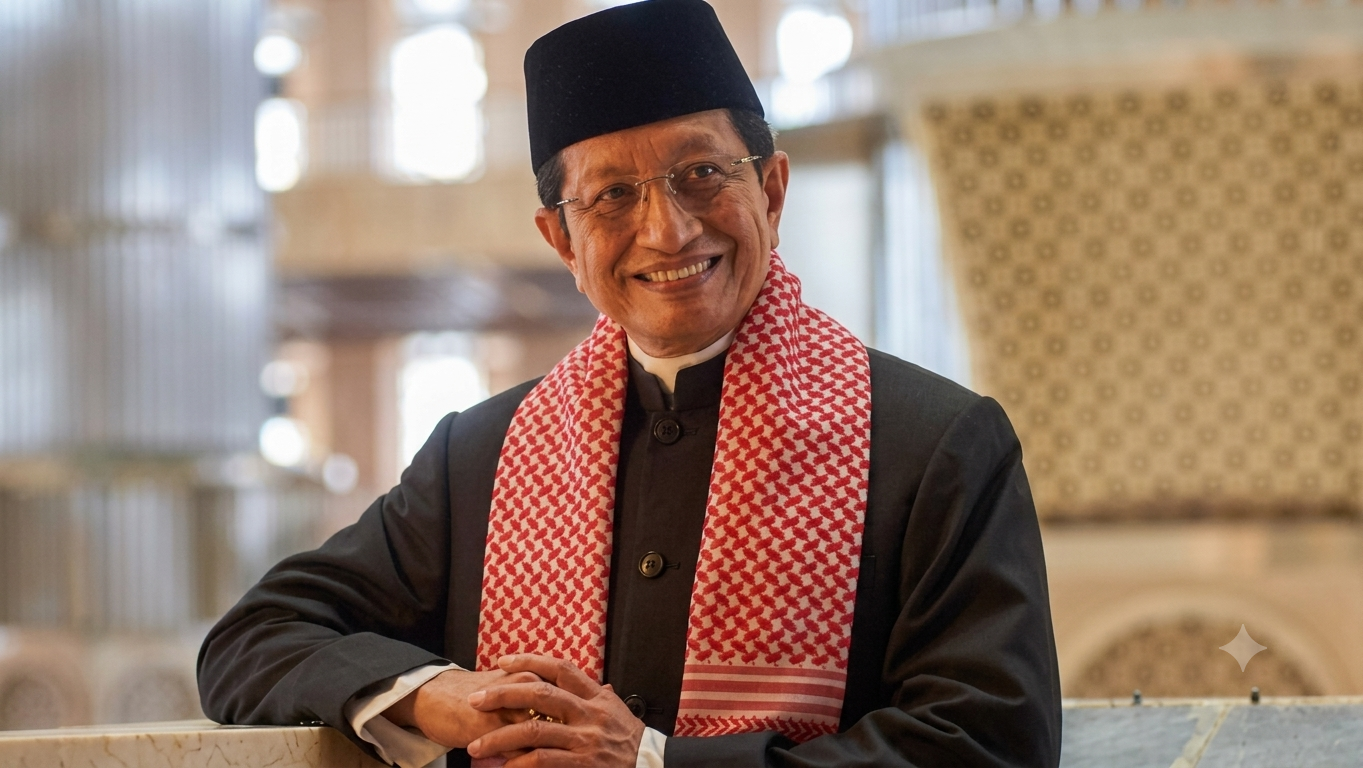
YOGYAKARTA — Indonesia’s Minister of Religious Affairs, Prof. Dr. KH. Nasaruddin Umar, M.A., has called on alumni of Jesuit educational institutions around the world to become builders of dialogue, guardians of peace, and promoters of global solidarity amid the multiple crises facing humanity today.
The message was delivered through a video address to thousands of delegates attending the 11th World Union of Jesuit Alumni (WUJA XI), gathered at the Driyarkara Auditorium of Universitas Sanata Dharma in Yogyakarta on Friday, July 31. In his remarks, the Minister extended his greetings to Fr. Arturo Sosa, SJ, Superior General of the Society of Jesus, the leaders of the World Union of Jesuit Alumni, the Rector of Universitas Sanata Dharma, delegates from various countries, and all distinguished guests.
On behalf of the Government of the Republic of Indonesia and the Ministry of Religious Affairs, Nasaruddin Umar expressed his gratitude and warmly welcomed all participants to the international congress. He said it was a great honor for Indonesia to host the global gathering of Jesuit alumni, whose shared commitment is rooted in service to young people and to humanity.
He stressed that the 11th WUJA Congress should not be viewed merely as a reunion of graduates from Jesuit educational institutions. Rather, he described it as an opportunity to renew a shared commitment to addressing the world’s pressing challenges, including humanitarian concerns, social justice, peacebuilding, and the search for a more balanced and humane society.
In his address, the Minister portrayed Indonesia as a living laboratory of religious coexistence. Grounded in the national ideology of Pancasila and the motto Bhinneka Tunggal Ika (Unity in Diversity), Indonesia demonstrates that diversity is not simply a slogan but a way of life and a collective mindset for fostering harmony.
“In the country with the world’s largest Muslim population, the Catholic community, Jesuit educational institutions, and people of all faiths live side by side in harmony, supporting one another and working together to build civilization,” he said in the recorded message.
Nasaruddin Umar also expressed his appreciation for the contribution of Jesuit educational institutions in Indonesia. According to him, Jesuit schools and universities are recognized not only for their academic excellence but, more importantly, for their success in forming well-rounded individuals.
He highlighted the distinctive Jesuit educational ideal of forming men and women for and with others—people who live not for themselves but in service to others regardless of religion, ethnicity, race, or social background. He said this vision is precisely what the world needs today.
The Minister then pointed to the multidimensional crises confronting humanity, including increasingly severe climate change, widening economic inequality, and geopolitical conflicts that threaten human dignity.
For this reason, he emphasized that religion and education must become part of the solution rather than sources of new divisions and problems.
During his message, Nasaruddin Umar also referred to Pope Francis’ teaching on universal fraternity as presented in the encyclical Fratelli Tutti. He likewise mentioned the Document on Human Fraternity for World Peace and Living Together, signed in Abu Dhabi, describing it as an important milestone in interreligious cooperation to address dehumanization and the environmental crisis.
According to the Minister, Jesuit alumni possess strong assets to respond to these global challenges. With their extensive international network, intellectual capacity, and spiritual depth, they carry a moral responsibility to become spaces of dialogue and agents of peace within the global community.
He encouraged all participants of WUJA XI to make the Yogyakarta congress an opportunity to strengthen global collaboration, promote harmony, deepen interreligious dialogue, and work together to safeguard the earth as a common home for future generations.
Concluding his message, the Minister invited the international delegates to experience the hospitality of the people of Yogyakarta and to witness firsthand how the values of tolerance and religious harmony are lived out in the daily life of Indonesian society.
He expressed hope that the 11th WUJA Congress would go beyond a ceremonial gathering and produce concrete ideas and practical initiatives that would contribute to the advancement of humanity and the promotion of lasting peace throughout the world.