


Writer: Fr. Agus Sriyono SJ, Collaborators: Agnes Riska & Widia Martina
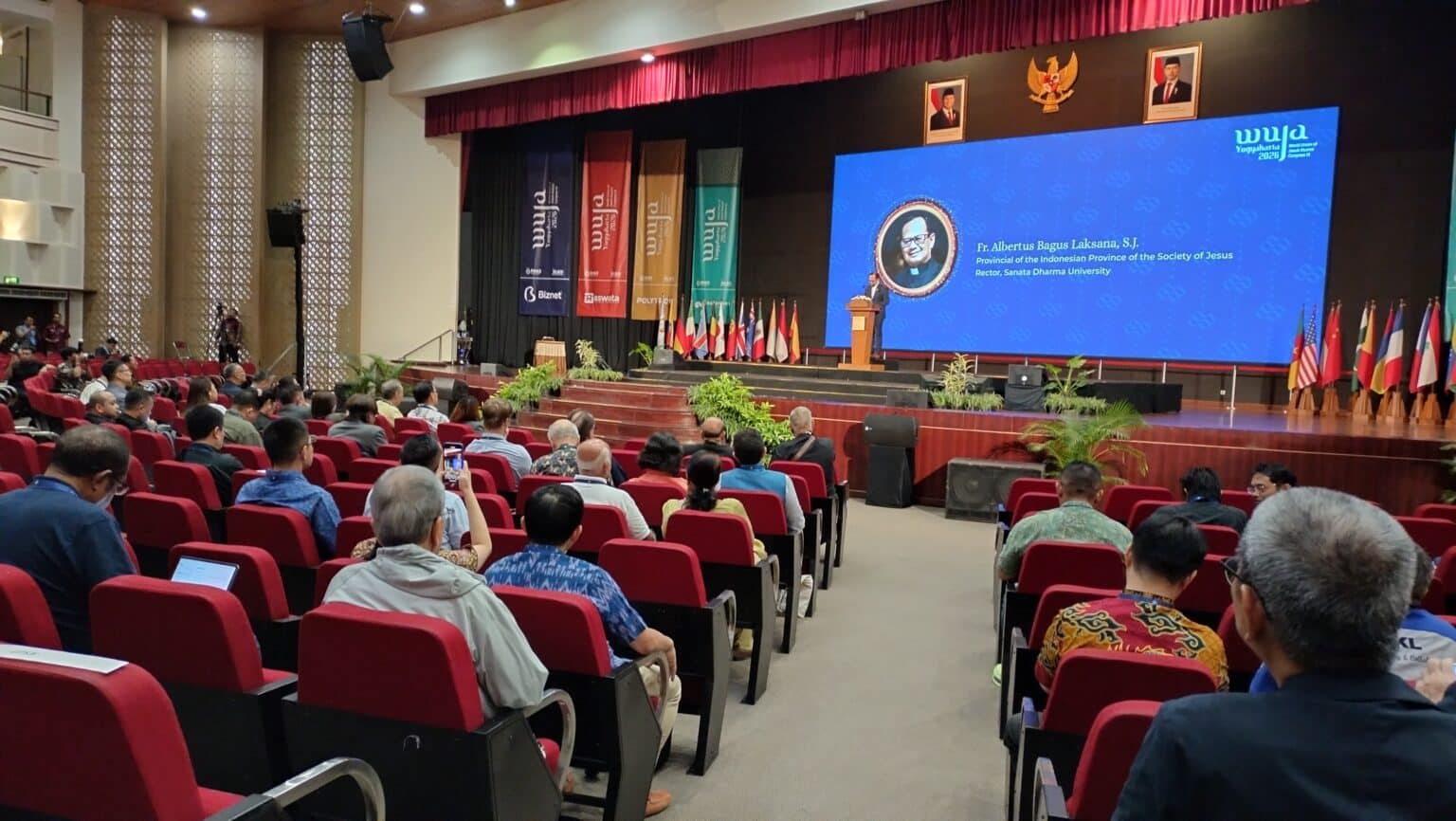
At the end of July 2026, Jesuit alumni from around the world gathered in Yogyakarta for the World Union of Jesuit Alumni Congress (WUJA) 2026. Speakers ranging from the Superior General of the Society of Jesus and Jesuit education leaders to alumni community organizers from different continents brought diverse perspectives to the gathering. Yet, they shared one important message: Jesuit education does not end when a student receives a diploma. It continues to live through the way we use the knowledge, experience, and values we have received to serve the world.
Among the many ideas that emerged during the congress, at least four seem particularly relevant for the community of Politeknik Industri ATMI: the call to stand at the frontier, the wise use of artificial intelligence, accompaniment of students, and the empowerment of alumni.
Mission at the Frontier
The congress opened with an address by Fr. Arturo Sosa, S.J., Superior General of the Society of Jesus. He emphasized that Jesuit alumni around the world are united not merely by memories of their respective schools or alma maters, but also by a common mission: to become companions in the work of reconciliation and justice.
He once again highlighted the four Universal Apostolic Preferences of the Society of Jesus: showing the way to God through discernment; walking with the poor and excluded; accompanying young people in building a future filled with hope; and caring for our common home, the earth.
One of the strongest ideas in his address was the concept of the “frontier.” A frontier does not necessarily mean a distant place at the edge of a map. Rather, it is any place where old ways are no longer sufficient and where we are challenged to search for new paths.
In today’s world, such frontiers can be seen in the development of technology and artificial intelligence, growing social and political polarization and populism, and the need to build genuine encounters across cultures—not simply coexistence amid differences.
Fr. Sosa’s message to alumni was simple yet challenging: we do not have to travel far to find the place where we are called to serve. Wherever our professions, families, and communities encounter difficult questions for which there are no easy answers, that is where we are called to be present.
For the Politeknik Industri ATMI community, this idea feels particularly relevant. As a vocational and technical institution preparing professionals for the industrial world, we are already standing at one of these frontiers—the frontier of technology itself.
The question, therefore, is no longer whether Politeknik Industri ATMI is close to the frontier. We are already there every day. The more important question is: do we face this frontier with clarity, reflection, and discernment, or do we rely solely on technical skills without stopping to ask what we are doing all this for, and whom it is ultimately meant to serve?
AI: A Tool, Not the Goal
At least three speakers at the congress identified artificial intelligence as one of the greatest challenges facing education and human formation today. Each approached the issue from a different perspective, but all three pointed toward a common thread.
Fr. Arturo Sosa, S.J., brought a Church perspective through the new encyclical of Pope Leo XIV, Magnifica Humanitas, which addresses human dignity in the midst of the development of artificial intelligence.
The encyclical uses two biblical images to frame the choices facing humanity: the Tower of Babel, as a symbol of human ambition that pursues efficiency at the expense of dignity and seeks to control everything without God; and the rebuilding of Jerusalem in the time of Nehemiah, as an image of shared responsibility capable of transforming diversity into communion.
From this perspective, the call to alumni is concrete: to resist discrimination produced by algorithms, demand transparency from those who develop and deploy AI, and defend workers whose livelihoods are threatened by automation.
Fr. Sosa also expands the classic Jesuit educational framework of the “4Cs”—competence, conscience, compassion, and commitment—into the digital world. Competence can no longer mean only professional expertise; it must also include digital literacy. Conscience means having the ability to discern whether technology is truly being used in ways that serve human dignity. Likewise, compassion and commitment need to be expressed in the way we relate to others and act in digital spaces.
John Tan of Wah Yan College, Hong Kong, brought the issue of AI closer to the classroom. He has witnessed firsthand how students are increasingly using AI to complete assignments and projects. At the same time, concerns about the future of work are also growing.
Yet the response he proposes is neither fear nor prohibition. Instead, he raises a simple but profound reflective question: who is actually shaping our desires—ourselves or the algorithms?
John Tan also described the development of AI in several stages. Initially, AI served mainly as a tool for writing assistance and information retrieval. It then developed into technology capable of automating various office tasks. Next, AI will become increasingly integrated with robotics and enter the physical world. Eventually, AI may become part of the infrastructure of everyday life, much like electricity.
The more routine tasks are taken over by AI, the more important it becomes for human beings to deliberately cultivate the abilities that must not be lost: judgment, creativity, imagination, relationships, and leadership. We must not allow these capacities to weaken simply because technology can perform many tasks faster.
Fr. Benedictus Hari Juliawan, S.J., placed the issue within the broader context of a rapidly changing world. We are experiencing profound disruption, marked by the growing power of technology companies and what he described as the “hacking” of human beings—a condition in which algorithms can sometimes recognize patterns in our behavior better than we recognize ourselves.
Yet the response is not despair. What is needed instead is self-discipline: the conviction that human beings are capable of change, the courage to hold on to a larger vision, and the willingness to begin with small, consistent habits.
Taken together, these three perspectives make one point increasingly clear: AI is a tool, not a replacement for human judgment, creativity, and conscience.
For this reason, these human capacities must be intentionally cultivated in our classrooms and workshops. The presence of technology should not make human abilities irrelevant. Instead, technology should encourage us to become even more conscious of what only human beings can do.
Accompanying Students: The “Emmaus” Way
One of the most practical ideas shared at the congress came from John Tan through a method of accompaniment inspired by the Gospel story of the two disciples walking toward Emmaus.
The method consists of four simple steps that can be applied by anyone—a lecturer, workshop instructor, staff member, or fellow student—when accompanying someone who is experiencing difficulty or uncertainty.
First, listen fully to the person’s experience. Do not rush to respond, let alone immediately offer a solution. Give the person space to tell their story and express their struggles.
Second, introduce a relevant principle or value, whether drawn from faith, Ignatian formation, or the wisdom of life.
Third, help the person connect their experience with that principle or value. The goal is not to provide an answer from the outside, but to help the person discover meaning for themselves.
Fourth, allow the process to lead toward a concrete decision or action. Accompaniment should not end with a conversation that merely feels good; it should help a person take a real step forward.
This approach is deeply consistent with the spirit of the frontier discussed earlier. Genuine accompaniment always begins with the humility to listen. We do not approach another person assuming that we already have all the answers. We walk alongside them as they search for the right path.
Alumni: From Memory to Mission
Several other speakers, including Clara Mejía Quintero from Colombia and Gabriel Calderón from Latin America, highlighted a pattern that can be found in many Jesuit alumni communities around the world.
A strong sense of connection to Jesuit values and identity generally remains. Yet active involvement, particularly in accompanying and mentoring younger generations, remains significantly lower than that sense of connection.
In other words, many alumni continue to hold warm memories of their alma mater, but not all have yet become actively and structurally involved in carrying forward the mission of education.
The message was straightforward: we do not need to wait until structures and resources are perfect before we begin.
We can start with concrete needs that can be addressed today. Becoming a mentor for students, participating in panel discussions, helping review curricula so they remain relevant to the needs of industry, opening internship opportunities, or expanding professional networks for Politeknik Industri ATMI graduates are all possible forms of engagement.
Trust and good structures are not competing alternatives. They can grow together and strengthen one another when alumni begin to engage in concrete action.
Education That Becomes Mission
Ultimately, education that remains only a memory becomes part of personal history. But education that continues to become service to others is transformed into mission.
WUJA 2026 reminds us that the mission of Jesuit education does not end when students leave the classroom. Instead, that mission takes on a new form through the way we use knowledge, technology, relationships, and experience to serve the world.
For Politeknik Industri ATMI, this calling means having the courage to stand at the forefront of technological and industrial development. At the same time, we are called to continue accompanying students wholeheartedly and to welcome alumni back as fellow companions in the mission.
Amid the rapid development of artificial intelligence, we must ensure that technology remains a tool for serving humanity, rather than gradually replacing the human capacity to think, create, build relationships, and choose what is good.
This spirit resonates with the idea of Hamemayu Hayuning Bawana expressed by Sri Sultan Hamengkubuwana X: progress and leadership cannot be separated from the responsibility to safeguard humanity, care for our common life, and protect the environment.
Therefore, the meaning of WUJA 2026 for us is not simply to bring home inspiration from Yogyakarta. The real challenge is to translate that inspiration into concrete action: to educate with heart, work with competence, use technology with wisdom, accompany others with care, and revitalize the alumni network as a force for service.
In this way, education does not remain a memory of what we once learned. It continues as a mission through what we do for others.
Go Forth, Set The World On Fire!