

YOGYAKARTA — In an age when social media rewards instant reactions, sharp arguments, and public confrontation, genuine dialogue has become increasingly difficult.
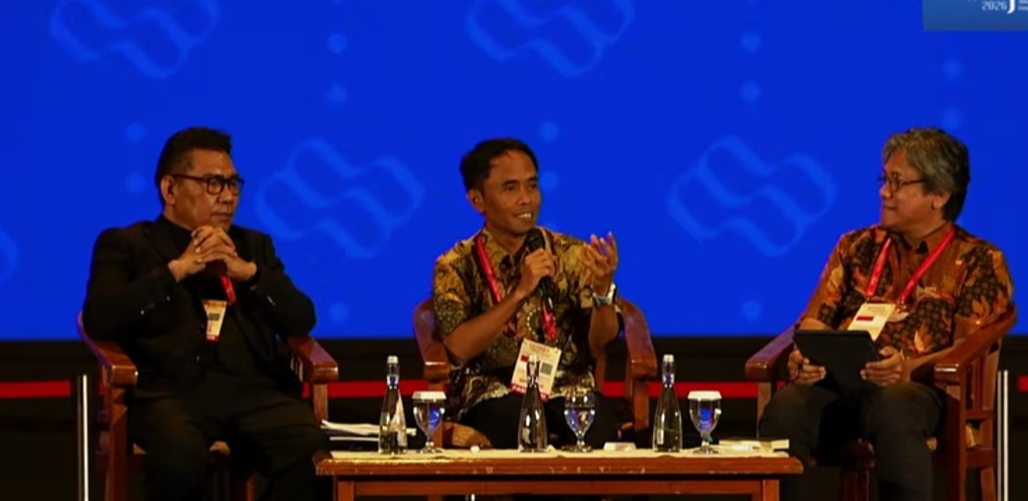
That challenge surfaced repeatedly during the question-and-answer session following presentations by Fr. Markus Solo Kewuta, SVD, an official of the Vatican’s Dicastery for Interreligious Dialogue, and Fr. Benedictus Hari Juliawan, SJ, former Provincial of the Jesuits in Indonesia, at the 11th World Union of Jesuit Alumni (WUJA XI) held at Universitas Sanata Dharma on Friday (July 31).
Rather than discussing theology in the abstract, participants turned the conversation toward one of the most pressing realities facing believers today: how to remain faithful to one’s convictions while living in an increasingly polarized world.
The discussion began with a reflection from Fr. Giulio Giulietti, SJ, a Jesuit from Georgetown University who has spent the past fourteen years working in Vietnam.
While praising Fr. Markus’ presentation on interreligious dialogue, Giulietti argued that the real challenge begins only after dialogue succeeds.
“The question is not simply how to begin dialogue,” he suggested. “The real question is what happens when genuine differences emerge.”
He noted that Pope Francis frequently speaks of dialogue leading to encounter, yet authentic encounters inevitably reveal profound disagreements. Those differences, he observed, can easily become personal unless people learn not only to listen but also to resolve conflicts while preserving friendship and mutual respect.
Fr. Markus responded by saying that the observation reflected one of the deepest realities of his nearly two decades of work at the Vatican’s Dicastery for Interreligious Dialogue.
“The longer I work in interreligious dialogue,” he said, “the more I discover our differences.”
Surprisingly, however, those differences have strengthened rather than weakened his Christian identity.
“The more I discover the differences,” he said, “the more I love my Christian faith.”
Dialogue, he explained, does not require believers to minimize theological differences.
Quoting Pope Benedict XVI, Fr. Markus acknowledged that theological dialogue is often extremely difficult because religious traditions hold fundamentally different beliefs.
Instead, authentic dialogue begins with a much simpler but far more demanding attitude: listening.
Before speaking, Christians are called to discern what is true in the experience of others. Referring to the Second Vatican Council’s declaration Nostra Aetate, he recalled that the Catholic Church recognizes “rays of truth” present in other religious traditions. Discovering those truths, he said, is impossible without first listening with humility.
The discussion then turned toward a question increasingly relevant for younger generations.
Vincentius Arya Prasada, an Indonesian alumnus of Gonzaga College, asked how interreligious dialogue could survive on social media, where conversations about religion frequently deteriorate into mockery, insults, and endless arguments.
Fr. Markus acknowledged that digital communication has created both remarkable opportunities and serious dangers.
Social media, he said, enables unprecedented interaction among people of different religions. Yet the same platforms often amplify hostility, reward provocation, and encourage users to ridicule the beliefs of others.
He referred to Pope Leo XIV’s recent concern over the ethical use of modern communication technologies, emphasizing that digital media and emerging technologies—including artificial intelligence—must always be employed for the good of humanity rather than as instruments of division.
Young people, he continued, deserve more than technological literacy.
Recalling a statement by former U.S. President Theodore Roosevelt, Fr. Markus argued that intellectual formation without moral formation ultimately becomes dangerous for society.
Education, therefore, must cultivate both intelligence and conscience, enabling young people to navigate digital spaces with wisdom, respect, and responsibility.
He concluded that peaceful communication ultimately depends on personal conversion.
Every user of social media, he said, must develop an interior awareness that rejects insults, avoids provoking conflict, and seeks instead to build peace and harmony. Religious leaders, political leaders, governments, educators, and ordinary citizens all share responsibility for shaping a healthier digital culture.
The final question shifted from dialogue to Jesuit spirituality.
A participant from Xavier University in the Philippines asked how Jesuit institutions balance cura personalis—care for the whole person—with their commitment to faith, justice, and social advocacy, particularly when such commitments expose individuals to conflict or personal risk.
Fr. Benedictus Hari Juliawan responded by suggesting that the question itself reflects only half of the Ignatian vision.
“Cura personalis,” he explained, “must always be understood together with cura apostolica—care for the mission.”
While Jesuit education rightly emphasizes the dignity and development of every individual, Ignatian spirituality ultimately places God’s mission first.
Mission, he said, provides the horizon within which personal care finds its deepest meaning.
That perspective, he admitted, may sound demanding in a culture that often identifies fulfillment with comfort or personal happiness.
“Ignatian spirituality,” Fr. Benny said, “does not teach us to seek happiness.”
Instead, it teaches believers to embrace God’s mission whatever the cost.
If that mission brings happiness, Christians should thank God. If it brings sacrifice instead, it still offers something even greater: meaning.
“Meaning,” he said, “is more important than happiness.”
Even so, he emphasized that Jesuit spirituality never ignores human needs.
People remain “flesh and blood,” he said. They need rest, friendship, encouragement, and mutual care.
The challenge is not choosing between mission and people but ensuring that care for one another always strengthens rather than replaces commitment to God’s mission.
As the discussion concluded, participants were left with a common message from both speakers.
Whether engaging followers of other religions, navigating the tensions of social media, or responding to the demands of justice and mission, authentic Christian leadership begins not with louder voices or stronger arguments, but with discernment, attentive listening, and the willingness to place God’s mission above personal comfort.