

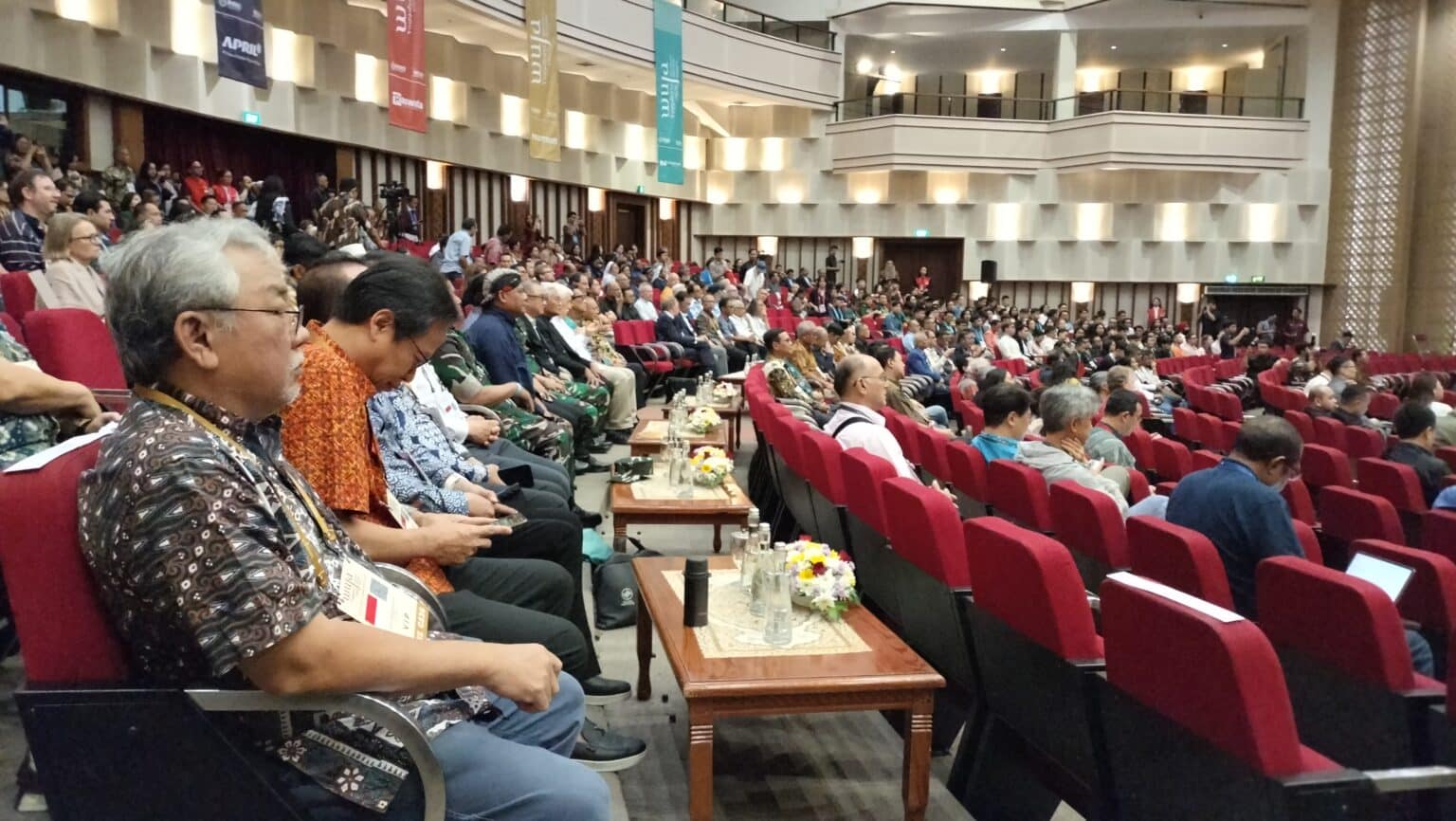
YOGYAKARTA, Indonesia — More than a thousand Jesuit alumni from across the globe gathered at the Driyarkara Auditorium of Sanata Dharma University on Thursday, July 30, for the opening of the 11th World Union of Jesuit Alumni (WUJA) Congress, marking the beginning of a five-day international assembly centered on Ignatian leadership, global collaboration, and service to humanity.
Held under the theme “United in Spirit, Leading with Purpose,” the congress is designed not merely as a reunion of graduates from Jesuit schools and universities but as a renewed commitment to respond to today’s global challenges through the values of Jesuit education and Ignatian spirituality. Throughout the congress, delegates will participate in keynote addresses, panel discussions, spiritual reflections, cultural immersions, and collaborative sessions culminating in the adoption of the Congress Resolutions and the WUJA Identity Manifesto.
Opening the congress, Fr. Bagus Laksana, SJ, Provincial of The Society of Jesus and host of WUJA XI, warmly welcomed delegates representing Jesuit institutions and alumni associations from every continent.
“Good morning, and welcome to the 11th World Union of Jesuit Alumni Congress 2026. On behalf of Sanata Dharma University, I would like to express our great joy and heartfelt gratitude for your presence on our campus,” he said at the beginning of his address.
Fr. Bagus described the congress as a tremendous honor not only for Sanata Dharma University but also for the people of Yogyakarta, a city long recognized as Indonesia’s cultural and educational capital.
He expressed particular appreciation to His Royal Highness Sri Sultan Hamengku Buwono X, Governor of the Special Region of Yogyakarta, for his presence and unwavering support for the congress. He also acknowledged the participation of the Regent of Sleman and local government leaders whose collaboration helped make the international gathering possible.
According to Fr. Bagus, the relationship between the Sultan and the Jesuit community extends far beyond official protocol. Over many years, the Sultan has demonstrated deep trust in Jesuit education, with members of the royal family themselves attending Jesuit schools.
“Thank you for the extraordinary hospitality extended by His Royal Highness and the entire royal family. Thank you for believing in Jesuit education as a place where future generations are formed,” Fr. Bagus said.
For him, that longstanding friendship symbolizes the close partnership between Jesuit educational institutions and the broader society of Yogyakarta. It also explains why the city provides an ideal setting for bringing together Jesuit alumni from around the world.
Turning to the delegates filling the Driyarkara Auditorium, Fr. Bagus invited everyone to recognize the significance of the moment.
“It is good to be here, isn’t it?” he asked, prompting enthusiastic applause throughout the hall.
He described the opening day of the congress as a privileged moment marked by joy, renewed energy, and gratitude.
“We all sense a real joy and a new energy whenever the Jesuit family is gathered together by the Lord Himself,” he said.
The congress, he noted, was further enriched by the presence of senior Jesuit leaders from Rome and across the world together with numerous members of the Society of Jesus.
He also welcomed Francisco Guarner, President of WUJA, along with members of the international executive committee and the Indonesian organizing committee, acknowledging the countless hours of preparation that made the congress possible.
Fr. Bagus paid special tribute to the local organizing team led by Mr. Purnomo Yusgiantoro, whose dedication over many months enabled delegates from around the world to gather in Yogyakarta.
One of the aspects that particularly delighted him was the extraordinary level of participation.
The congress, he announced, had attracted more than one thousand registered delegates, making it one of the largest gatherings in the history of WUJA.
“Perhaps this is a new record for WUJA,” he remarked with a smile. “I’ll have to check with the organizing committee later.”
“But beyond the numbers,” he continued, “what truly amazes me is the energy, the enthusiasm, and the genuine eagerness that has brought us together.”
For Fr. Bagus, that enthusiasm reflects the enduring vitality of the global Jesuit alumni network. Although graduates now serve in vastly different professions, cultures, and societies, they remain united by the educational and spiritual formation they received through Jesuit institutions.
That unity, he stressed, carries an even deeper significance in today’s fractured world.
“In a world divided by conflicts, tensions, and polarization, our genuine desire to gather here in Yogyakarta sends a powerful message of unity to the world,” he said.
He emphasized that WUJA is far more than an alumni association. It is a global community of women and men formed by Jesuit education who now serve as educators, public officials, entrepreneurs, scientists, journalists, Church leaders, and professionals in countless fields.
When they come together, they do not merely reconnect with old friends; they bring together diverse experiences, cultures, languages, and perspectives shaped by a common Ignatian vision.
It is within that context that the congress theme, “United in Spirit, Leading with Purpose,” takes on its fullest meaning.
Fr. Bagus explained that unity does not imply uniformity. Delegates come from different countries, traditions, and social realities, yet they share a common commitment to God’s mission in the world.
“Our deepest desire is to remain united in the same spirit as we participate in God’s mission. We aspire to become partners in vision and leaders of a particular kind,” he said.
Such leadership, he explained, differs fundamentally from models based on power, prestige, or personal ambition.
Instead, Ignatian leadership is rooted in a profound relationship with God and with others. It calls people to remain deeply grounded in their own local realities while remaining attentive to the needs and concerns of the global community.
The mission of Jesuit alumni, therefore, is not simply to succeed professionally but to exercise leadership that promotes dialogue, justice, solidarity, and reconciliation across cultures and societies.
For Fr. Bagus, this calling has never been more urgent.
At a time when societies are increasingly marked by political polarization, social fragmentation, and international conflict, Jesuit alumni are uniquely positioned to become bridges between communities rather than participants in division.
His opening address set the tone for the entire congress: a gathering not defined by nostalgia, but by a renewed commitment to place Jesuit education at the service of humanity and to cultivate leaders capable of building a more just, peaceful, and united world.
For Fr. Bagus Laksana, SJ, the choice of Yogyakarta as the host city for the 11th World Union of Jesuit Alumni (WUJA) Congress carries a significance that extends far beyond logistics or convenience. It reflects the very identity of a city where culture, education, dialogue, and faith have converged for generations, making it an ideal place for Jesuit alumni from around the world to reflect on their shared mission.
Continuing his opening address at the Driyarkara Auditorium of Sanata Dharma University on Thursday, July 30, Fr. Bagus challenged delegates to see the congress not simply as a series of conferences and meetings but as an opportunity to experience a city whose history embodies many of the values promoted by Jesuit education.
“Yogyakarta is the right and unique place for our gathering,” he said. “It is a city of culture and education built through the rich encounters of different cultures and religious traditions over many centuries.”
According to Fr. Bagus, Yogyakarta has long served as a meeting point where diversity is not regarded as a threat but as a source of enrichment. Different communities, traditions, and faiths have contributed to shaping the city’s distinctive character, making dialogue an integral part of its identity.
He noted that Catholic institutions and Jesuit ministries have also played an important role in this historical development. Through schools, universities, pastoral initiatives, and social ministries, the Jesuit network has contributed to the intellectual, cultural, and spiritual life of the region.
Today, he said, Yogyakarta continues to grow as a global city while remaining deeply committed to preserving its traditions of cultural exchange and religious harmony.
For that reason, he encouraged participants not merely to remain inside conference halls but to encounter Yogyakarta itself during the congress.
That invitation is reflected throughout the congress program. Alongside keynote addresses and plenary discussions, delegates will journey to the historic Ganjuran Church, visit Borobudur and Prambanan temples, participate in discussions on leadership, faith and justice, ecology, and digital transformation, and collaborate in drafting resolutions that will guide WUJA into the coming years.
For Fr. Bagus, these experiences are not side activities.
They are an essential part of learning.
Learning from Fr. Nicolaus Driyarkara
Standing inside the auditorium named after Fr. Nicolaus Driyarkara, SJ, the renowned Indonesian philosopher and one of the founders of Sanata Dharma University, Fr. Bagus invited delegates to draw inspiration from the Jesuit thinker whose vision continues to shape the university.
He explained that although Fr. Driyarkara never explicitly used the expression “global citizen,” his philosophy anticipated many of the ideas now associated with global citizenship.
At the heart of Driyarkara’s anthropology is the conviction that the human person is fundamentally relational.
Human beings, Fr. Bagus explained, are capable of crossing boundaries, appreciating the beauty found in others, establishing meaningful relationships, and collaborating for the common good.
“His philosophy emphasizes the social and cultural dimensions of being human,” Fr. Bagus said. “It highlights our capacity to cross boundaries, to be attracted by the beauty of others, to build deeper relationships, and to work together for the common good.”
For Jesuit alumni, he continued, this understanding of the human person should become more than an academic concept.
It should shape the way they live, lead, and engage society.
Jesuit education has never sought merely to produce competent professionals or accomplished leaders. Rather, it forms women and men capable of dialogue, discernment, solidarity, and service—people who recognize that genuine leadership begins with respect for the dignity of every human person.
A World Facing Dehumanization
Yet Fr. Bagus warned that this vision of humanity is increasingly under threat.
Modern society, he observed, is confronted by powerful forces that diminish human dignity and weaken the bonds that unite people.
Political polarization, economic inequality, technological disruption, cultural fragmentation, and violence all contribute to what he described as the growing dehumanization of contemporary society.
“In our world today,” he said, “this vision of the human person is being eclipsed by different dehumanizing forces.”
Such realities, he argued, make the vocation of Jesuit alumni even more urgent.
Those formed within Jesuit institutions cannot remain passive observers.
Whether serving in government, education, business, science, journalism, civil society, or the Church, they are called to become witnesses to human dignity and agents of reconciliation.
Professional success alone is no longer enough.
Leadership must ultimately be measured by one’s willingness to protect human dignity and to promote justice and peace.
Responding to Pope Leo XIV’s Call
Fr. Bagus then connected this responsibility with the teaching of Pope Leo XIV, referring to the Holy Father’s encyclical Magnifica Humanitas.
He urged delegates to embrace the Pope’s appeal to place the dignity of every person at the center of public life and to become active builders of unity in an increasingly divided world.
“We should heed Pope Leo XIV’s call to uphold the dignity of the human person and to work for unity and peace throughout the world,” he said.
For him, this is precisely where the worldwide network of Jesuit alumni can make a distinctive contribution.
Spread across every continent and active in virtually every profession, Jesuit alumni possess a unique opportunity to build bridges across cultures, religions, political differences, and social divisions.
The congress itself, he suggested, stands as a visible expression of that possibility.
More than one thousand delegates representing numerous nations, cultures, and languages have gathered not despite their differences, but because of a common spiritual heritage that encourages dialogue rather than exclusion.
Beyond Conferences: A Transformative Experience
As he approached the conclusion of his address, Fr. Bagus reminded participants that the congress should not be reduced to a sequence of presentations, discussions, or organizational meetings.
Important as those activities may be, they are only instruments.
The true purpose of WUJA XI, he insisted, is personal and communal transformation.
Over the coming days, delegates will listen to distinguished speakers, participate in workshops and panel discussions, strengthen international partnerships, and develop strategic priorities for the future of WUJA.
These conversations will culminate in the adoption of the Congress Resolutions and the WUJA Identity Manifesto, providing a renewed vision for the organization’s mission in the years ahead.
Yet Fr. Bagus expressed an even deeper hope.
“I hope this congress will become a truly transformative experience for all of you as we reflect together on the strategic issues that will shape our identity, our organization, and our collaboration for mission in today’s global world,” he said.
Ultimately, however, he emphasized that authentic transformation does not arise from strategic planning alone.
It is the work of the Holy Spirit.
“More importantly,” he concluded, “I hope you will experience the unifying and transforming presence of the Holy Spirit throughout this entire process.”
Before leaving the podium, Fr. Bagus invited the audience to recognize the enormous dedication of the organizing committee, whose months of preparation had made the international gathering possible.
He asked delegates to offer a warm round of applause in appreciation for their service before wishing every participant a fruitful and grace-filled congress.
His address established the spiritual and intellectual foundation for WUJA XI.
Rather than focusing on institutional achievements or organizational matters, Fr. Bagus challenged Jesuit alumni to rediscover the deeper purpose of their education: to become women and men capable of crossing boundaries, defending the dignity of every human person, fostering dialogue across differences, and exercising leadership rooted not in power, but in service.
As delegates begin five days of reflection, prayer, dialogue, and cultural immersion in Yogyakarta, his message will likely remain the defining invitation of the congress: that Jesuit alumni are called not only to remember where they were educated, but to live out that education as builders of unity and hope in an increasingly fragmented world.