

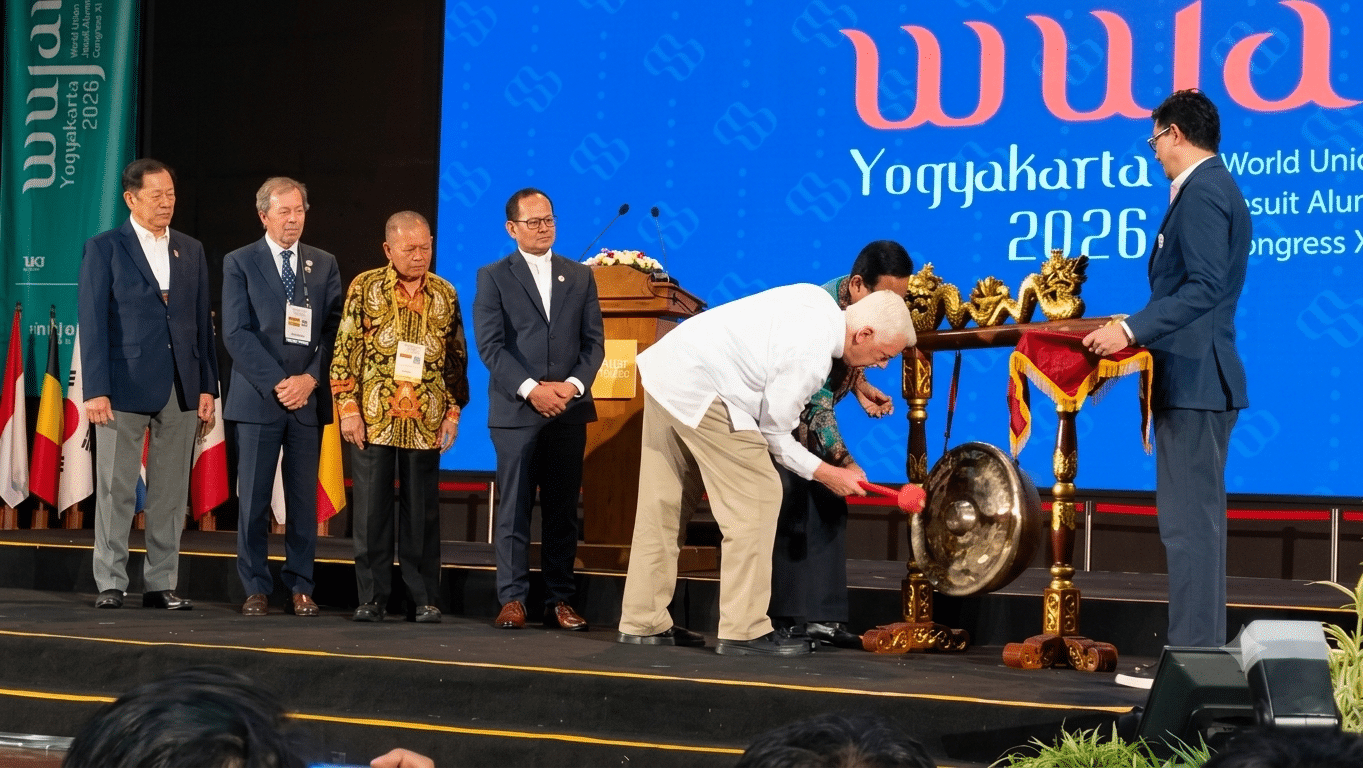
YOGYAKARTA — The future of Jesuit education cannot be understood merely as the preservation of a centuries-old tradition. Rather, it must be seen as a living mission that continually invites people to become companions in reconciliation, justice, and hope.
That was the central message delivered by Father Arturo Sosa, SJ, Superior General of the Society of Jesus, as he addressed delegates gathered for the 11th Congress of the World Union of Jesuit Alumni (WUJA). Speaking before alumni from every continent, he called participants to move beyond memories of their years in Jesuit schools and universities and rediscover their vocation as collaborators in God’s mission in today’s rapidly changing world.
Opening his address, Father Sosa expressed gratitude to the organizers, to the leadership of the World Union of Jesuit Alumni, to the Indonesian Province of the Society of Jesus, and to the host institutions whose efforts made the international gathering possible. He also acknowledged the thousands of alumni who had traveled from different countries, cultures, professions, and walks of life, united by a common spiritual heritage despite their diversity.
Together, he said, they gathered above all to give thanks to God for the many blessings received throughout their lives.
The theme of the Congress, “United in the Spirit, Called to a Shared Mission,” is both an invitation and a challenge. It invites alumni not to remain attached merely to memories of their education in Jesuit institutions, but to recognize that the Ignatian tradition is meant to shape a lifelong commitment to reconciliation and justice.
Being united in the Spirit, Father Sosa explained, means much more than sharing a common educational background. It means allowing the Holy Spirit to become the force that binds people together into one apostolic body, regardless of nationality, profession, culture, or social status. The purpose of this unity is participation in Christ’s mission of reconciling humanity with God, with one another, and with creation itself.
To develop this reflection, Father Sosa proposed six major points, beginning with the mission entrusted by the Church to the Society of Jesus.
The Mission Entrusted to the Society of Jesus
Father Sosa recalled that the Society of Jesus underwent an unprecedented process of communal discernment following the 36th General Congregation held in 2016. Rather than allowing a small leadership group to determine future priorities, Jesuits around the world, together with their collaborators in mission, participated in a lengthy process of prayer, consultation, and discernment.
The process involved Jesuit communities, apostolic institutions, provinces, regional conferences, and the central leadership of the Society. Pope Francis accompanied the discernment from the very beginning, first by approving the process itself, then by following its development, and finally by confirming its results.
After more than two years of prayerful reflection, Pope Francis formally approved the Universal Apostolic Preferences, presenting them not simply as strategic objectives but as the specific mission entrusted by the Church to the Society of Jesus. Father Sosa invited participants to recall these four preferences carefully, paying attention to the action verbs that define them.
The first preference is to show the way to God through the Spiritual Exercises and discernment. The second is to walk with the poor, the excluded, and those whose dignity has been violated in a mission of reconciliation and justice. The third is to accompany young people in the creation of a hope-filled future. The fourth is to collaborate in the care of our Common Home. These priorities, he stressed, are not isolated initiatives but form one integrated vision of apostolic life.
Among them, Pope Francis repeatedly emphasized the first preference as the foundation upon which all the others depend. Every authentic Christian mission begins with a living relationship with Christ nourished through prayer and discernment. Without this spiritual foundation, every apostolic effort risks becoming merely another social project or institutional program.
Father Sosa noted that this mission has continued to receive the support of the Church’s leadership. During a meeting with the Major Superiors of the Society of Jesus in October 2025, Pope Leo XIV reaffirmed the same apostolic direction and encouraged Jesuits to continue serving at the frontiers of today’s world—whether geographical, cultural, intellectual, or spiritual.
According to Father Sosa, every Pope since the Second Vatican Council has consistently entrusted the Society of Jesus with this mission of presence at the frontiers.
He recalled how Pope Paul VI encouraged Jesuits to serve wherever the Church faced its greatest challenges and ideological crossroads. Pope Benedict XVI later called Jesuits to become men of deep faith, sound culture, and profound human sensitivity, especially where faith and reason meet.
Pope Leo XIV, Father Sosa continued, has expanded this vision even further by encouraging Jesuits to embrace today’s frontiers not as places of fear but as opportunities for creative missionary engagement.
Frontiers are places where familiar answers are no longer sufficient. They require discernment, courage, imagination, and complete trust in Christ. Just as Saint Ignatius and generations of Jesuit missionaries ventured into unknown territories with confidence in God’s guidance, today’s disciples are called to respond creatively to the unprecedented challenges of the contemporary world.
Returning to the first Universal Apostolic Preference, Father Sosa underlined the irreplaceable role of the Spiritual Exercises of Saint Ignatius. The Exercises remain the privileged path through which individuals discover God’s call in their lives and learn to make decisions rooted in genuine spiritual freedom.
For this reason, one practical consequence of embracing the Universal Apostolic Preferences is ensuring that the Spiritual Exercises become available to as many people as possible, particularly young people seeking meaning and direction in an increasingly uncertain world.
Without a profound life of prayer leading to personal and communal discernment, Father Sosa warned, the Universal Apostolic Preferences could easily be misunderstood as institutional objectives or management plans. Such a reduction would empty them of their deepest meaning, which is collaboration in the mission of Jesus Christ entrusted to the whole Church.
Saint Ignatius himself discovered that authentic apostolic service begins only when individuals allow God to transform them from within. Only then do they become true companions in mission, capable not only of walking toward God themselves but also of helping others discover that same path.
The Spirit that creates this unity, Father Sosa emphasized, is the Holy Spirit—the Spirit of God—not merely a shared enthusiasm or common organizational identity. It is the Holy Spirit who gathers diverse people into one apostolic body whose head is the crucified and risen Christ.
From this communion flows the Church’s mission of reconciliation and justice, embracing not only relationships among human beings but also humanity’s relationship with the whole of creation.
Father Sosa concluded this first section with a personal invitation to every participant. He encouraged alumni to experience the Spiritual Exercises in whatever form might be available to them and invited those who feel called to become guides of the Exercises themselves, helping others encounter this spiritual treasure.
The Spiritual Exercises, he reminded the assembly, do not belong exclusively to Jesuits. They are a gift entrusted to the whole Church for the service of humanity and the greater glory of God.
A Call to the Frontiers: Faith, Artificial Intelligence, and the Future of Humanity
Having reflected on the spiritual foundation of the Society of Jesus through the Universal Apostolic Preferences, Father Arturo Sosa turned to what he described as one of the defining realities of our age: the call to stand courageously at the frontiers of history.
Referring to Pope Leo XIV’s recent address to the Major Superiors of the Society of Jesus, Father Sosa said the Holy Father has invited Jesuits—and all those who share the Ignatian mission—to embrace a renewed apostolic imagination marked by courage, creativity, and discernment.
The Pope’s invitation comes at a time when humanity is experiencing what many observers describe not simply as an era of change, but as a change of era. The transformation unfolding today reaches far beyond technological innovation. It is reshaping culture, economics, politics, education, and even the ways people understand themselves and relate to one another.
For Father Sosa, these profound changes are not reasons for fear but invitations to missionary engagement. Christ continues to send His disciples into the world, and it is precisely into this changing historical landscape that the Society of Jesus has been called to serve.
Among today’s emerging frontiers, he highlighted one in particular: technology, especially artificial intelligence. Artificial intelligence, he observed, offers enormous possibilities for advancing human flourishing. At the same time, it also presents serious risks that cannot be ignored. It may contribute to isolation, replace meaningful employment, manipulate human behavior, and reshape social relationships in ways that threaten the dignity of the human person.
For this reason, Father Sosa insisted, the Church cannot remain a passive observer of technological development. Instead, she has the responsibility to help guide these developments according to ethical principles rooted in the Gospel, always defending human dignity and promoting the common good.
This concern, he noted, has found its fullest expression in Pope Leo XIV’s recent encyclical Magnifica Humanitas, a document dedicated to safeguarding the central place of the human person in the age of artificial intelligence.
Father Sosa described the encyclical as both a warning and a source of hope. It recognizes that digitalization, artificial intelligence, and robotics have already become integral parts of everyday life. They increasingly influence how decisions are made, how information is shared, and how societies imagine the future.
Technology itself, he emphasized, is neither inherently good nor inherently evil. Its moral character depends on how human beings choose to design, govern, and employ it. To illuminate this challenge, Magnifica Humanitas draws upon two powerful biblical images.
The first is the Tower of Babel, representing humanity’s temptation to pursue technological achievement without reference to God. It symbolizes a project driven by self-assertion, where efficiency replaces dignity and power becomes an end in itself.
The second image is the rebuilding of Jerusalem under Nehemiah. Unlike Babel, Nehemiah’s work was grounded in prayer, shared responsibility, and trust in God. It became a collaborative effort that transformed diversity into communion and rebuilt a city where every person had a place.
Father Sosa urged the audience to embrace Nehemiah’s vision as the model for rebuilding today’s fractured world. “Our task,” he suggested, “is not merely to construct more advanced technologies, but to rebuild the social fabric of humanity.”
At the heart of Magnifica Humanitas, he continued, lies a fundamental affirmation: every human being possesses an inalienable dignity that no circumstance can erase.
This dignity does not depend on productivity, intelligence, social status, or economic usefulness. Rather, it is rooted in the fact that every person is created by God and loved by Him without condition.
In the age of artificial intelligence, however, society faces the growing temptation to reduce human beings to measurable data. Success is increasingly evaluated through algorithms, efficiency, and performance indicators, while personal worth risks being judged by productivity alone.
Against this trend, the Church speaks with unmistakable clarity. The human person must always remain the end of every technological development—never merely its instrument.
Addressing the Jesuit alumni gathered before him, Father Sosa emphasized that this teaching is not intended only for theologians or Church leaders. It is a responsibility shared by every graduate of Jesuit educational institutions, regardless of profession or vocation.
Whether working in government, business, education, science, technology, healthcare, or civil society, alumni are called to embody the Church’s social teaching by promoting ethical frameworks for the development and use of artificial intelligence. This commitment includes resisting every form of algorithmic discrimination and insisting upon transparency, accountability, and fairness among those who design and govern technological systems.
Equally important, Father Sosa said, is defending the dignity of workers whose livelihoods and working conditions may be threatened by the rapid expansion of automation and artificial intelligence. Technological progress must never come at the expense of human dignity. Above all, he reminded participants that there are dimensions of human existence no machine will ever be able to reproduce.
Love cannot be automated. Friendship cannot be programmed. Conscience cannot be generated by algorithms. Nor can genuine human affection be replaced by artificial systems. These are uniquely human gifts, reflecting the image of God within every person. Father Sosa then broadened his reflection beyond technology to the wider realities shaping contemporary society.
Humanity today, he observed, continues to suffer from devastating wars, widespread violence, increasing political polarization, growing populism, institutional distrust, and the deliberate creation of false realities that distort truth itself. Communities are becoming fragmented, public discourse increasingly hostile, and many societies deeply divided.
It is precisely within this context, he said, that Christians are called to become instruments of reconciliation and justice. Echoing the message of Magnifica Humanitas, Father Sosa urged alumni to become artisans of dialogue, recognizing that authentic dialogue is one of the most effective paths toward fraternity and the building of what Pope Paul VI once called a “civilization of love.”
Dialogue, he insisted, should never be mistaken for weakness. On the contrary, genuine dialogue requires the courage to recognize another person as a brother or sister, even amid profound disagreement. For those formed in the Ignatian tradition, this responsibility carries particular significance. Jesuit education has always sought to form people capable of building bridges rather than walls.
Graduates are therefore called to become bridges between cultures, between generations, between the powerful and the marginalized, between faith and society, and between communities divided by fear or misunderstanding.
Being a bridge, Father Sosa explained, is not simply performing a particular activity. It is a way of living. A bridge fulfills its purpose only when others are able to cross it. In the fullest sense, Christ Himself is that bridge.
Through His Cross, Jesus united heaven and earth, reconciled humanity with God, and opened the way for every people and every culture to encounter divine love. For Christians, every effort toward dialogue, reconciliation, and justice ultimately finds its model in the Crucified and Risen Lord. Thus, standing at today’s frontiers—whether technological, cultural, political, or spiritual—is not merely an institutional strategy for the Society of Jesus.
It is an expression of the Church’s enduring mission to proclaim hope in a rapidly changing world and to ensure that every human advance remains firmly rooted in the dignity of the human person created in the image of God.
Companions in a Mission of Reconciliation and Justice
Having reflected on the call to engage the frontiers of today’s world, Father Arturo Sosa turned to what he described as the very heart of the Ignatian vocation: becoming companions in the mission of reconciliation and justice.
The theme of the Congress, “United in the Spirit,” he explained, is far more than an inspiring slogan chosen for an international gathering. It expresses the deepest identity of the Jesuit apostolic mission and the enduring vocation shared by Jesuits and those who have been formed in Ignatian educational institutions.
What binds Jesuit alumni together is not simply the memory of classrooms, campuses, or years spent in Jesuit schools and universities. Those experiences are important, but they point toward something much greater—a lifelong commitment to participate in God’s work of healing a fractured world.
Father Sosa recalled the message he shared during the Tenth World Union of Jesuit Alumni Congress in Barcelona in 2022. Four years later, he said, that invitation has become even more urgent.
“The Lord continues to invite us,” he affirmed, “to learn how to collaborate as companions in a shared mission.” During the past several years, Jesuits and countless lay collaborators throughout the world have been engaged in the often challenging but deeply enriching process of learning what genuine apostolic collaboration truly means.
This journey, Father Sosa observed, has revealed that collaboration is not merely an organizational necessity brought about by changing demographics or the declining number of Jesuits in some parts of the world. Rather, it is a grace through which God is forming a new apostolic culture—one in which every individual contributes unique gifts while remaining united by a common purpose.
The Society of Jesus has gradually come to understand that the Holy Spirit calls the Church to a culture of collaboration characterized by mutual trust, complementary vocations, and shared responsibility. Every person brings gifts that others do not possess.
Every vocation enriches the whole. No one can fulfill the mission alone. For this reason, Father Sosa urged the alumni to continue asking themselves how new forms of collaboration can contribute to the reconciliation of all things in Christ. To help explain this vision, he turned to one of Saint Paul’s most enduring images: the Church as the Body of Christ.
Quoting the Apostle’s First Letter to the Corinthians, Father Sosa reminded the assembly that while there are different gifts, there is only one Spirit; while there are different ministries, there is only one Lord; and while there are different forms of service, it is the same God who works through all of them.
Every member of the body possesses a distinct function. The foot cannot dismiss the hand. The ear cannot envy the eye. Nor can the head declare that it has no need of the feet. Each member is indispensable because every gift has been given for the common good.
This biblical image, Father Sosa explained, profoundly shaped the vision of Saint Ignatius of Loyola himself.
Ignatius understood the Society of Jesus not as an organization requiring uniformity, but as a living body composed of people with remarkably different talents, cultures, personalities, and ministries, all united in mind and heart by the same apostolic mission.
The Society of Jesus, therefore, does not seek to reproduce identical structures wherever it is present. Its universality lies precisely in its capacity to embrace diversity while remaining faithful to a common purpose. Differences are not obstacles to unity. They are expressions of God’s generosity. When people with different gifts allow themselves to be guided by the Holy Spirit, diversity becomes strength rather than division.
Father Sosa noted that the Universal Apostolic Preferences provide this shared direction for the entire apostolic body. They express concretely how the Society of Jesus participates in the mission entrusted by Christ to the Church.
These preferences, he said, are not human strategies but fruits of spiritual discernment confirmed by the Holy Father. Because they arise from attentive listening to the Holy Spirit, they help Jesuits and their collaborators overcome every temptation toward self-centeredness, institutional isolation, or corporate self-interest.
Instead, they invite everyone to become authentic collaborators in the Lord’s mission—a mission shared with countless people both within and beyond the visible boundaries of the Church. Responding to this invitation means recognizing that every culture, every association, every profession, and every community possesses gifts capable of enriching the larger apostolic body.
Collaboration, Father Sosa emphasized, must therefore be understood in its fullest spiritual meaning. “We do not simply work together,” he explained. “We are companions.” To be companions is to share the same bread. To walk the same road. To serve the same Lord.
Such companionship is rooted not in efficiency or convenience but in communion. It expresses something essential about the Church herself. Father Sosa then reflected on the complementary vocations of Jesuits and lay people. The Society of Jesus contributes a distinctive spiritual tradition marked by prayer, the Spiritual Exercises, communal apostolic discernment, intellectual rigor, and a particular way of proceeding grounded in the Constitutions of the Order.
Lay collaborators, meanwhile, bring indispensable gifts shaped by their professional expertise, family life, creativity, civic engagement, and daily presence in the worlds of politics, economics, science, culture, education, and the arts. Neither vocation is complete without the other. Together they form an apostolic body far greater than the sum of its individual members.
This relationship should never be understood as one group assisting another. Rather, Jesuits and lay people are equally called by Christ to serve the one mission of the Church, each according to the vocation they have freely embraced. For this reason, Father Sosa rejected any understanding of collaboration as merely a practical response to contemporary circumstances.
“Becoming companions,” he said, “is not a strategy. Becoming companions is a grace.”
Over recent decades, Jesuit schools, universities, and apostolic institutions throughout the world have evolved into authentic communities of shared mission where Jesuits, lay women and men, and members of other religious congregations increasingly work together as genuine partners.
The growing presence of lay leadership within Jesuit institutions, Father Sosa explained, should never be interpreted simply as compensation for declining numbers of Jesuits. Instead, it reflects a deeper movement of the Holy Spirit and fulfills the ecclesiology envisioned by the Second Vatican Council. Practical collaboration has gradually matured into something much richer—a shared missionary identity that itself becomes a living witness to the communion at the heart of the Gospel.
Such a shared mission, however, requires formation.
Jesuits and lay collaborators alike must cultivate an authentic spiritual life, deepen their commitment to Gospel values, become familiar with the Ignatian tradition, and develop habits of both personal and communal discernment. Only then can professional relationships mature into genuine vocational partnerships. Every individual is called by God through his or her unique gifts, circumstances, and vocation. The challenge is not merely to work within Jesuit institutions but to recognize one’s participation in Christ’s mission through those institutions.
This understanding transforms ordinary collaboration into a profound experience of ecclesial communion. It becomes a visible expression of a Church that journeys together—united by the Holy Spirit, enriched by diversity, and committed to the work of reconciliation entrusted by Christ to all His disciples.
The Second Vatican Council, Father Sosa continued, provides the theological foundation for this vision. In Apostolicam Actuositatem, the Council teaches that lay men and women possess a unique vocation: to make the Church present and fruitful in those places and circumstances where only they can become the salt of the earth. Likewise, Lumen Gentium affirms that the entire People of God—not only the clergy or religious—shares in Christ’s prophetic mission.
For Father Sosa, these teachings remain as relevant today as ever. The lay vocation is neither secondary nor derivative. It is a full participation in Christ’s mission, exercised precisely in the midst of the world—in workplaces, families, civic life, culture, and society.
He also acknowledged that many graduates of Jesuit institutions are not Catholics, and some do not profess any Christian faith at all. Yet many of them have embraced the values that characterize the Ignatian tradition: a commitment to justice, solidarity, human dignity, and care for creation.
These women and men, he said, have become generous collaborators in the service of humanity. Their contribution demonstrates that the Ignatian tradition has always possessed a universal horizon. Its aim has never been limited to forming members of one religious community, but rather to helping people seek God in all things and serve humanity in all its diversity.
The apostolic body, therefore, is enriched by every person of goodwill who offers his or her talents, conscience, and commitment to the common mission.
Father Sosa illustrated this openness by recalling the experience of Saint Peter in the house of Cornelius. Peter came to realize that God shows no partiality and that the Holy Spirit acts freely beyond the boundaries that human beings often establish. The outpouring of the Spirit upon the Gentiles revealed that God’s grace cannot be confined by ethnicity, culture, or previous religious assumptions.
This biblical experience, Father Sosa suggested, remains a lesson for the Church today.
One of the great challenges of the present age is learning to recognize where the Holy Spirit is already at work. That requires what the Society of Jesus has increasingly sought to cultivate: a culture of communal discernment.
Such a culture calls people to listen attentively to one another, to read the signs of the times with spiritual sensitivity, to make decisions together, to practice accountability, and to trust that the Spirit speaks through every member of the apostolic body.
It also demands moving beyond individualism and institutional self-sufficiency toward genuine interdependence, where Jesuits and lay people, women and men, believers of different traditions, and people from diverse cultures discover that they truly need one another in order to serve Christ’s mission faithfully.
“This,” Father Sosa concluded, “is the kind of apostolic collaboration to which the General Congregations of the Society of Jesus have consistently called us—and it is the model that Jesuit alumni are invited to embody wherever they live and work.”
Walking Together: Synodality as the Way Forward
After reflecting on collaboration in mission, Father Arturo Sosa turned to another frontier that he believes will shape the future of the Church: the journey of synodality. Referring once again to Pope Leo XIV’s address to the Major Superiors of the Society of Jesus, Father Sosa noted that one of today’s most significant apostolic frontiers lies not outside the Church, but within her own life and structures.
The synodal path, he explained, is an invitation to deepen the Church’s capacity to listen—first to the Holy Spirit and then to one another—so that her ministries, institutions, and structures may become more transparent, more missionary, and more faithful to the Gospel.
Father Sosa acknowledged that synodality is not yet fully understood or universally embraced. Many still view it with uncertainty or suspicion. Yet, he insisted, synodality is not a passing pastoral initiative. It is rooted in the Second Vatican Council’s understanding of the Church as the People of God journeying together in response to Christ’s call.
The Church, he said, is not defined simply by its structures or hierarchy. It is a community of believers gathered by the Holy Spirit to continue the evangelizing mission entrusted by the Crucified and Risen Lord to His disciples.
Seen in this light, the theme of the 11th World Union of Jesuit Alumni Congress—“United in the Spirit, Called to a Shared Mission”—captures the very essence of synodality.
To be united in the Spirit means learning to walk together while remaining attentive to the newness that Jesus Christ continually brings into history. His gift of life opens a path of hope for all humanity, and it is along this shared path that the Church discovers her missionary identity.
Father Sosa explained that Pope Leo XIV is inviting the whole Church to embrace this mission in a genuinely synodal manner.
Such a way of proceeding requires listening not only to bishops, priests, and religious, but also to lay women and men, young people, and all people of goodwill. It means recognizing that the Holy Spirit can speak through every member of the People of God.
The Holy Father’s vision, Father Sosa continued, has consistently presented the Church as a missionary community that builds bridges rather than barriers—a Church committed to dialogue, reconciliation, and hospitality, always ready to welcome those who seek compassion, accompaniment, and hope.
For the Society of Jesus, this invitation has particular significance.
Since its foundation, the Society has cultivated the practice of communal discernment. Jesuits have long sought to make important decisions through prayerful listening, attentive dialogue, and openness to the movements of the Holy Spirit. Father Sosa suggested that this Ignatian tradition offers an important contribution to the wider synodal journey of the Church.
The more Jesuits and their lay collaborators become women and men formed in personal and communal discernment, the more they will be able to help build a Church that genuinely listens before acting, discerns before deciding, and responds not according to the logic of power but according to the logic of love.
He also recalled Pope Francis’ repeated warnings against every form of clericalism and ideological rigidity. There is always a temptation, Father Sosa noted, for individuals or groups to believe that they alone possess the correct answers or fully understand God’s will. Such attitudes inevitably lead to exclusion, polarization, and division.
Synodality offers an antidote to this temptation.
It reminds believers that no individual, no group, and no institution possesses the fullness of wisdom. Rather, the Holy Spirit distributes gifts throughout the entire People of God, calling the Church to discern together the signs of the times.
For this reason, Father Sosa drew attention to a formation initiative known as “Walking the Way,” a program designed to help lay people, Jesuits, priests, and members of other religious congregations grow in the practice of both personal and communal discernment.
He encouraged alumni to take advantage of such initiatives as concrete ways of strengthening unity in the Spirit and deepening their shared missionary commitment. Communities capable of genuine discernment, he argued, may well become one of the Society of Jesus’ most valuable contributions to both the Church and the contemporary world.
Interculturality: Discovering Unity Through Diversity
Father Sosa then shifted his attention to another defining characteristic of the Jesuit mission: interculturality. Looking across the Congress hall, he said, he saw a living image of humanity in all its richness. Delegates had come from different nations, languages, cultures, professions, and life experiences. Yet despite these differences, they had gathered around a common formation and a common mission.
This diversity, he observed, was not accidental. Rather, it reflected one of the deepest dimensions of the Ignatian vocation. Interculturality is far more than peaceful coexistence among people from different backgrounds. It is not simply the ability to tolerate differences or to live under the same roof without conflict. Authentic interculturality is something much deeper.
It is a mutual exchange in which different cultures encounter one another with openness, allowing every participant to be enriched and transformed through that encounter. Such a process begins by recognizing one’s own cultural identity honestly and critically.
Only then can genuine dialogue emerge with people whose histories, customs, and worldviews differ from one’s own. As relationships deepen, diversity becomes not a threat but a source of mutual enrichment, enabling people to share life, hope, and faith while contributing their unique cultural gifts to a common human family. For Father Sosa, this dynamic reflects the true meaning of universality.
The Church becomes genuinely universal not by erasing differences but by embracing them. Unity does not require uniformity. Instead, the Holy Spirit gathers many cultures into one communion without destroying their distinctiveness. Interculturality, therefore, represents both a frontier and a grace. It is a frontier because it calls people beyond the comfort of familiar institutions, national identities, and social circles.
It invites them to encounter those who are different, to cross cultural boundaries, and to respond together to the broader needs of humanity.
At the same time, it is a grace because such encounters expand the human heart. They make people more attentive to the action of the Holy Spirit in places they may never have expected. The Spirit of God, Father Sosa emphasized, is never confined to a single culture.
The Holy Spirit works freely among peoples and nations, fostering dialogue, reconciliation, and mutual enrichment across every cultural boundary. To illustrate this vision, Father Sosa referred to the Second Vatican Council’s Pastoral Constitution Gaudium et Spes, which opens with its memorable affirmation that the joys and hopes, the griefs and anxieties of the people of this age—especially the poor and those who suffer—are also the joys and hopes, griefs and anxieties of the followers of Christ.
For Father Sosa, these words reveal the profoundly intercultural heart of the Gospel. Nothing genuinely human lies outside the concern of those who allow themselves to be guided by the Holy Spirit.
Consequently, Jesuit education seeks not merely to impart academic knowledge but to cultivate openness toward peoples, cultures, and perspectives different from one’s own. Graduates of Jesuit institutions should emerge as women and men capable of living in a pluralistic world without fear, contributing their own traditions while remaining receptive to the gifts of others.
In a world increasingly fractured by ideological conflicts, religious extremism, political polarization, and cultural suspicion, Father Sosa argued that interculturality has become one of the Church’s most important contributions to peace. Today’s societies urgently need people capable of building trust across differences.
They need women and men who listen before speaking, who seek understanding before judgment, and who approach others not with fear but with respect. Such people become authentic bridge-builders. This, Father Sosa concluded, has always been one of the central goals of Jesuit education. Its purpose is to form individuals capable of dialogue, reconciliation, and service—people who can build bridges between cultures, communities, and nations, thereby contributing to a more peaceful and fraternal world.
An Educational Tradition with a Past, a Present, and a Future
As he entered the final part of his address, Father Arturo Sosa invited the delegates to reflect on the enduring mission of Jesuit education. Looking beyond the Congress itself, he challenged alumni to consider not only what they had received from their education, but also what they had become because of it.
The true measure of Jesuit education, he argued, is not found in academic rankings, institutional prestige, or historical achievements. Its deepest success is revealed in the lives of those who have passed through Jesuit schools and universities and who continue to transform society through their personal and professional commitment.
To illustrate this point, Father Sosa recalled an address delivered by Father Peter-Hans Kolvenbach, SJ, at Santa Clara University. Kolvenbach emphasized that the real value of Jesuit education is measured by the kind of women and men it forms—individuals who dedicate themselves to serving others and contributing to the transformation of society.
In the context of the 11th World Union of Jesuit Alumni Congress, Father Sosa said, this insight acquires renewed significance. The gathering itself bears witness to the continuing commitment of Jesuit alumni throughout the world to building more just relationships, defending human dignity, and creating conditions in which every person can flourish.
Such efforts, he explained, represent the true fruit of the educational mission to which the Society of Jesus remains committed. Father Sosa then returned to one of the foundational principles of Ignatian pedagogy.
More than three decades ago, Father Kolvenbach reminded educators that the purpose of Jesuit education is to form “men and women for others.” This vision, first articulated with particular clarity in the early 1990s, continues to guide Jesuit educational institutions across the world.
From this educational philosophy emerged what has become widely known as the Four Cs—the four essential characteristics that Jesuit education seeks to cultivate in every student. Graduates of Jesuit institutions should become competent, conscientious, compassionate, and committed. These four qualities, Father Sosa explained, continue to provide an integrated vision of human excellence, capable of responding to the challenges of every generation.
The first characteristic is competence.
Competence goes far beyond academic achievement or professional expertise. It includes the capacity to continue learning throughout one’s life, to ask critical questions, to exercise sound judgment, and to place one’s talents at the service of others.
A competent person does not accumulate knowledge merely for personal success but seeks to use that knowledge responsibly for the common good.
The second characteristic is conscience. A person of conscience has cultivated a rich interior life through reflection, prayer, and discernment. Such a person is capable of distinguishing between good and evil, not simply by following public opinion or social pressure, but by listening attentively to the deeper movements of truth within the human heart. Conscience enables individuals to act with integrity even when doing so requires personal sacrifice.
The third characteristic is compassion. Compassion begins with the ability to recognize the suffering of others and to respond with genuine solidarity. It is the capacity to encounter every person as someone created in the image of God, regardless of social status, nationality, religion, or circumstance. For Father Sosa, compassion transforms education from an intellectual exercise into an authentic human vocation.
The fourth characteristic is commitment. Commitment is what moves a person from sympathy to action. It is the willingness to persevere in working for justice, to confront structures of inequality, and to participate courageously in the long and often difficult task of transforming society. A committed person does not merely recognize problems but accepts responsibility for becoming part of the solution.
Father Sosa observed that these four characteristics remain profoundly relevant in today’s rapidly changing world. Yet they must continually be interpreted in light of emerging realities, especially the unprecedented technological transformations that now shape human life.
In the era of artificial intelligence, competence must include digital literacy and the wisdom to use technology ethically and responsibly. Conscience must extend into the digital environment, enabling people to discern how technological innovation affects human dignity and the common good. Compassion must also embrace those who are excluded by the digital divide or marginalized by technological change, ensuring that progress benefits all rather than only a privileged few.
Commitment, meanwhile, now includes working for just governance of artificial intelligence and advocating ethical standards capable of protecting the dignity of every human person in an increasingly digital world.
Father Sosa emphasized that Jesuit education cannot remain indifferent to these developments. Rather, it must continue preparing future generations to respond creatively and responsibly to the complex moral questions emerging from scientific and technological progress.
He also noted that this year marks another important milestone in the history of Jesuit education: the anniversary of the document Characteristics of Jesuit Education, published nearly four centuries after the historic Ratio Studiorum of 1599. The principles outlined in that document, he said, remain remarkably relevant today.
Over the years they have been further developed through subsequent texts, including Ignatian Pedagogy: A Practical Approach (1993) and Jesuit Education: A Living Tradition (2019).
Taken together, these documents articulate a comprehensive educational vision that extends well beyond the transmission of academic knowledge. Jesuit education seeks the integral formation of the whole person. It educates not only the mind, but also the heart, the conscience, and the will. Its ultimate purpose is to prepare women and men capable of serving others generously and working for the greater glory of God.
Father Sosa reminded the delegates that this educational tradition remains a living reality rather than a historical legacy. Its vitality depends not simply on educational institutions but on the countless alumni who embody its values in their daily lives. Every graduate, regardless of profession or vocation, carries forward the Ignatian mission by promoting justice, reconciliation, dialogue, and hope within society.
A Call to Build the Future Together
Bringing his address to a close, Father Sosa expressed confidence that the 11th World Union of Jesuit Alumni Congress would bear lasting fruit far beyond the days of the gathering itself. The Congress, he said, represents both the culmination of a long journey and the beginning of a new chapter.
It offers an opportunity to harvest the fruits of decades of collaboration while planting new seeds for the future. Participants had come together from every corner of the world because they shared not only a common educational heritage but also a common calling.
Now, they were being invited to return home with renewed determination to place their gifts at the service of humanity during this historic period of profound global transformation. Father Sosa urged the alumni to make full use of the many resources available within the Ignatian tradition in order to respond creatively to the challenges of the present age.
Humanity, he observed, cannot continue along paths marked by discrimination, exclusion, domination, and the instrumentalization of persons or cultures. Neither can the law of the strongest—which manifests itself in countless forms of violence, oppression, and endless wars—continue to shape the future of the world.
Instead, he called for a civilization founded upon dialogue, mutual recognition, and fraternity. The task before Jesuit alumni is to become women and men capable of helping others discover peaceful ways of resolving conflicts and living in harmony with one another and with creation. The World Union of Jesuit Alumni, Father Sosa suggested, will grow stronger if it commits itself to concrete and achievable steps that can be implemented at every level of the organization.
Only through practical initiatives rooted in the Spirit will the Union continue expanding its contribution to reconciliation, justice, and peace in the years ahead. Father Sosa acknowledged that the road toward peace is neither simple nor short. Its complexity should never discourage those who have committed themselves to Christ’s mission. Peace requires perseverance, patience, and the unwavering conviction that God Himself is the true protagonist of history.
Human beings are not the authors of salvation. They are collaborators invited to participate in God’s work. For this reason, Father Sosa concluded his address with profound gratitude. He thanked the Lord for all that has already been accomplished through the World Union of Jesuit Alumni across so many parts of the world.
He expressed particular appreciation for the growing experience of being “families in mission”—Jesuits, alumni, collaborators, and friends united by the same Spirit and the same desire to serve the Church.
Finally, he thanked the Congress for the opportunity to share not only his reflections but also his hopes for the future. His prayer, he said, is that Jesuits and alumni alike may continue growing together as companions in mission, offering ever more generous service to the Church and to Christ, who gave His life for every human being.
With those words, Father Arturo Sosa brought his address to a close, leaving the delegates with a clear and compelling invitation: to carry the Ignatian spirit far beyond the walls of Jesuit institutions, becoming bridge-builders, agents of reconciliation, and faithful companions in God’s mission for the world.
Beyond the Congress: A Mission That Continues
For Father Arturo Sosa, the conclusion of the 11th World Union of Jesuit Alumni Congress should not be understood as the end of a gathering, but as the beginning of a renewed commitment shared by thousands of alumni around the world. The Congress, he suggested, should become a point of departure from which participants return to their countries carrying not only memories of conversations and friendships, but also a clearer sense of mission. The Ignatian spirit that has brought them together must now find concrete expression in their families, professions, communities, and societies.
Throughout his address, Father Sosa repeatedly returned to one central conviction: the world does not simply need more successful professionals or more influential institutions. It needs women and men who are spiritually grounded, intellectually discerning, ethically responsible, and deeply committed to reconciliation.
That mission, he emphasized, belongs not only to Jesuits but also to every person who has been shaped by the Ignatian tradition. Whether serving as educators, scientists, entrepreneurs, public officials, journalists, lawyers, physicians, engineers, artists, or community leaders, Jesuit alumni have the opportunity—and the responsibility—to embody the values they received through their formation.
They are called to become agents of dialogue in societies marked by polarization, defenders of human dignity in cultures increasingly driven by efficiency and technological power, and witnesses of hope in a world often overshadowed by violence, exclusion, and despair.
Father Sosa reminded the delegates that the challenges confronting humanity today are too complex for any single institution or organization to address alone. Climate change, forced migration, armed conflicts, widening economic inequality, technological disruption, and cultural fragmentation require collaborative responses that transcend national borders, political ideologies, and religious affiliations.
For that reason, he once again stressed the importance of building networks of collaboration rooted in trust, mutual respect, and shared discernment. The World Union of Jesuit Alumni, he said, possesses a unique opportunity to become precisely such a network. Present on every continent and represented in countless professions, Jesuit alumni form a global community capable of contributing to the transformation of society in ways that no individual institution could accomplish on its own.
Yet Father Sosa cautioned that such influence should never be measured merely by numbers, prestige, or organizational expansion. The true strength of the alumni movement lies in its fidelity to the Gospel and to the Ignatian vision of service. Its effectiveness will depend on whether its members remain united by the Holy Spirit and continually discern how best to respond to the needs of the times.
Rather than pursuing ambitious programs for their own sake, Father Sosa encouraged the Union to identify concrete and realistic initiatives that can be implemented at every level of the organization. Even small actions, when rooted in genuine discernment and carried out with perseverance, can become seeds of profound transformation.
History, he observed, repeatedly demonstrates that lasting change often begins with communities willing to take faithful and courageous first steps. The Society of Jesus itself was born not from elaborate institutional planning but from a small group of companions who allowed themselves to be guided by God’s Spirit.
That same Spirit, Father Sosa said, continues to guide the Church today. For this reason, he urged alumni never to lose confidence, even when confronted by the immense complexity of contemporary challenges. The path toward reconciliation and peace has never been easy.
It demands patience, perseverance, humility, and an unwavering trust that God remains present and active in history. Christians do not carry the burden of saving the world by their own efforts. Rather, they participate in the mission that already belongs to God. “The Lord is the true protagonist,” Father Sosa reminded the assembly.
Human beings are invited to become generous collaborators in that divine work. This conviction, he explained, frees believers from both discouragement and triumphalism. Success is not measured solely by visible achievements, nor should setbacks become reasons for despair. Faithfulness to the mission, openness to the Holy Spirit, and perseverance in service remain the essential criteria of Christian discipleship.
As he concluded his address, Father Sosa expressed heartfelt gratitude to everyone who had contributed to the life and mission of the World Union of Jesuit Alumni. He thanked the organization’s leaders, the local organizers, the volunteers, and the countless alumni who continue to dedicate their time, talents, and resources to strengthening the global Ignatian community.
He also expressed particular appreciation for the growing experience of what he described as “families in mission”—Jesuits, lay collaborators, alumni, and friends working side by side in service of the Church. This growing culture of collaboration, he said, is one of the clearest signs of hope for the future.
Rather than seeing themselves as separate groups with different interests, they increasingly recognize themselves as members of one apostolic body united by a common purpose. Father Sosa closed his address on a note of hope. He expressed his confidence that the fruits of the Congress would continue to mature long after the delegates returned home, inspiring new initiatives, deeper collaboration, and renewed commitment to reconciliation and justice.
His final words echoed the central message that had shaped the entire address. To be “United in the Spirit” is not simply to share a common history. It is to embrace a common future. It is to recognize that the Holy Spirit continues to call women and men from every nation, culture, and profession to become companions in Christ’s mission.
And it is to respond to that call with courage, generosity, and hope, trusting that the work of reconciliation belongs first to God, who invites His people to become faithful co-workers in building a more just, peaceful, and fraternal world.