

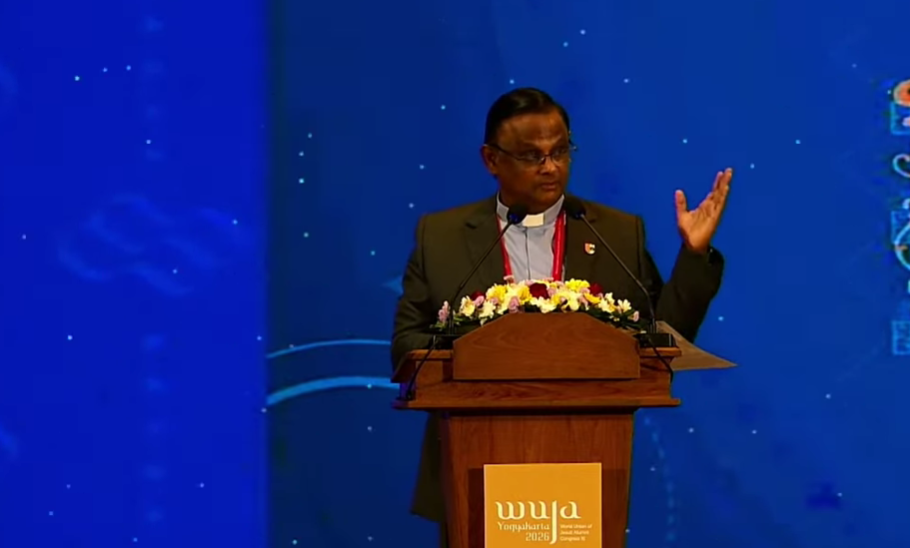
YOGYAKARTA, Indonesia – Jesuit education can no longer rely solely on Jesuits to carry forward its mission. Alumni must become partners in mission, sharing responsibility for building a more just, peaceful, and sustainable world. This was the central message of Fr. Dominic Savio SJ, Principal of St. Xavier’s College, Kolkata, India, during his presentation entitled Reclaiming the Ignatian Vision in a World of Disconnection: Partnership Among Jesuits, Alumni, and Institutions as the New Apostolic Frontier at the 11th World Union of Jesuit Alumni Congress, held at the Driyarkara Auditorium of Sanata Dharma University in Yogyakarta, Indonesia, on Thursday, July 30, 2026.
Addressing Jesuits, university leaders, alumni representatives, students, and delegates from around the world, Fr. Dominic began by reminding participants that they had gathered not simply as representatives of institutions or nations, but as members of one global Ignatian family united by the spirituality of St. Ignatius of Loyola and by a shared mission to form women and men committed to justice, peace, and the care of our common home.
Quoting Jesuit Superior General Fr. Arturo Sosa SJ, Fr. Dominic emphasized that the mission does not belong exclusively to the Society of Jesus. Rather, it is God’s mission, inviting Jesuits, alumni, educators, students, and collaborators alike to become one apostolic body working together for reconciliation and hope in today’s world.
Fr. Dominic described today’s world as living through a profound paradox. While technology has connected humanity more than ever before, it has also intensified loneliness, social fragmentation, political polarization, widening economic inequality, environmental degradation, and a growing loss of meaning, particularly among young people. In South Asia, he noted, these realities are reflected in poverty, communal tensions, social exclusion, ecological vulnerability, and unequal access to education. Such challenges, he said, make Jesuit education more relevant than ever in forming leaders capable of building bridges of dialogue and bringing hope to society.
Against this backdrop, Fr. Dominic called for a new relationship between Jesuit institutions and their alumni. Traditional models centered on nostalgia, reunions, or fundraising, he argued, are no longer sufficient. Instead, alumni should be recognized as co-owners of the Ignatian mission, sharing genuine responsibility for shaping the future of Jesuit works.
“Alumni are not merely former students,” he said. “They are the living expression of the Ignatian mission in society. Through them, the values cultivated in Jesuit education continue transforming the world.”
He observed that Jesuit alumni today serve in virtually every sector of society—including government, business, law, education, healthcare, research, the arts, media, and social advocacy—forming one of the Society of Jesus’ greatest global resources. However, this tremendous potential can only be realized if alumni are actively involved in discernment, governance, decision-making, and mission implementation within Jesuit institutions.
Fr. Dominic proposed a paradigm shift built on three key transitions: from affiliation to co-responsibility, from nostalgia to mission, and from passive membership to active partnership. He noted that this evolution reflects the thinking of successive Jesuit Superior Generals—from Fr. Pedro Arrupe SJ to Fr. Arturo Sosa SJ—who have increasingly emphasized collaboration between Jesuits and lay partners as an essential dimension of the Church’s apostolic mission.
Within the framework of the Society of Jesus’ Universal Apostolic Preferences (UAPs), Fr. Dominic outlined four principal areas where alumni can make a lasting contribution. They are called to help people deepen their relationship with God through Ignatian spirituality, accompany the poor and marginalized through their professional expertise, promote ecological conversion and care for creation, and mentor young people through leadership formation, professional networking, and vocational accompaniment rooted in Gospel values.
As a practical example, he highlighted the work of the Federation of Jesuit Alumni Associations of India, whose initiatives include disaster relief, healthcare services, expanded educational opportunities, women’s empowerment, community development, and environmental stewardship. Such experiences, he said, demonstrate that goodwill alone is insufficient. Lasting social transformation requires strong organizational structures, sustained collaboration, and well-developed networks.
Fr. Dominic also stressed the importance of lifelong formation for alumni. Ignatian education, he said, does not end at graduation. Rather, graduates need ongoing opportunities for spiritual growth, ethical reflection, retreats, mentoring, leadership development, and faith-sharing communities to help them integrate faith with professional responsibility amid increasingly complex social realities.
Addressing global challenges such as climate change, migration, armed conflict, and economic inequality, Fr. Dominic urged Jesuit alumni around the world to strengthen international collaboration. No single institution or Jesuit province, he argued, can adequately respond to these issues alone. Instead, the worldwide Ignatian network must become a global movement capable of coordinated action in humanitarian service, social justice, youth accompaniment, and environmental protection.
Toward the conclusion of his presentation, Fr. Dominic identified three priorities for the future: deepening alumni engagement in the mission, strengthening collaboration across institutions and countries, and investing in the lifelong formation of alumni. The future of the Ignatian mission, he said, depends on the willingness of the entire Ignatian family to journey together as one living apostolic body.
During the question-and-answer session, Fr. Dominic affirmed that the empowerment of women has long been an integral part of the Jesuit mission. Every Jesuit school, university, and apostolic work, he said, is called to accompany women, the poor, and marginalized communities according to local realities. He also encouraged educational institutions to introduce students to the Universal Apostolic Preferences before graduation so they clearly understand the Society’s apostolic vision as future alumni.
Concluding his address, Fr. Dominic invited participants to leave Yogyakarta not merely inspired but transformed—with renewed commitment to collaborate more deeply, serve more generously, and love more courageously. When Ignatian spirituality is united with the energy, expertise, and influence of alumni, he said, it becomes a global movement capable of fostering reconciliation, inspiring hope, and bearing witness to God’s mission in the world.
“The world is waiting. The mission is calling. Do not shrink your mission,” Fr. Dominic concluded, echoing the words of Fr. Arturo Sosa SJ.