

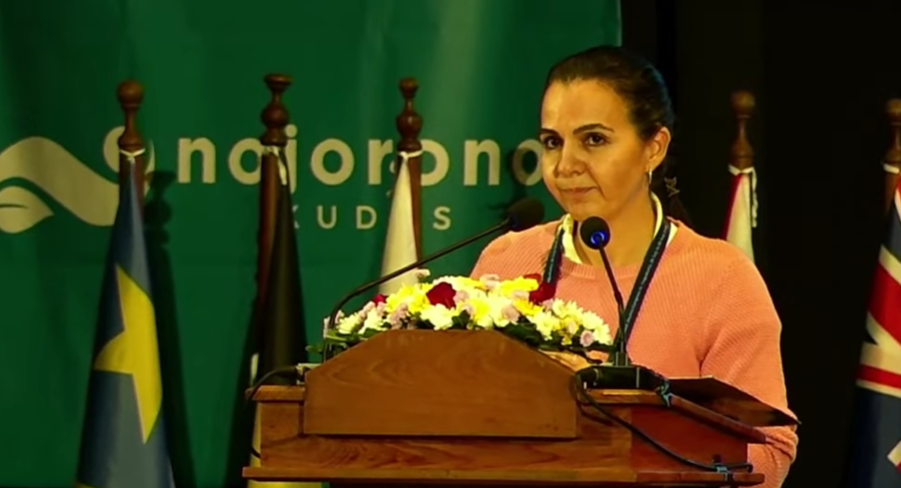
YOGYAKARTA – The mission of education does not begin with the construction of school buildings or the provision of impressive facilities. True mission begins by building relationships, fostering trust, and walking alongside communities. This was the central message delivered by Pilar Lopez-Dafonte Suanzes, a humanitarian advocate from Fe y Alegría, during the 11th World Union of Jesuit Alumni (WUJA) Congress in Yogyakarta.
Addressing Jesuit alumni from around the world, Pilar chose not to begin by explaining the history or organizational structure of Fe y Alegría. Instead, she opened her reflection with a simple yet profound question.
“What motivates someone to spend hours every day teaching while sitting on nothing more than a simple mat?” she asked the delegates.
Through that question, Pilar shared stories drawn from nearly four years of accompanying Fe y Alegría’s educational mission across Asia. She admitted that she initially arrived in Cambodia believing she would be contributing to educational development. Instead, the experience transformed her own perspective.
“Asia has taught me far more than I have ever been able to give,” she said.
During her service, Pilar visited schools and learning centers in Cambodia, Nepal, the Philippines, Indonesia through the Kanisius Foundation, Laos, and Vietnam. Everywhere she went, she encountered teachers, young people, and local communities who demonstrated that education is far more than classroom instruction—it is a movement of hope that empowers lives.
One story that left a lasting impression on her was that of Lada, a young Cambodian woman who had once been a student at a Fe y Alegría learning center before returning as a teacher.
Every afternoon, Lada drove a small tuk-tuk to remote villages along the Thai border. The vehicle carried more than a teacher—it served as a mobile library. Inside were books for children who often spent their days alone because their parents worked far from home or because they were being raised by their grandparents.
Rather than waiting for children to come to the learning center, Lada brought education to them. In village yards, open fields, or beneath the shade of trees, she spread out a simple mat, opened her box of books, and transformed ordinary afternoons into opportunities for reading, learning, and play.
For Pilar, Lada’s story was never simply about the dedication of one remarkable teacher. What impressed her even more was the network of people supporting that mission—families, fellow educators, young volunteers, local communities, and the entire Fe y Alegría team. It was there, she said, that she learned no one carries out a mission alone.
Her second lesson came from Nepal. Together with the International Coordinator of Fe y Alegría and Jesuit companions, she traveled for five hours through mountain roads to Pantan, a remote Himalayan community served by only one public secondary school.
There she encountered Fe y Alegría Nepal’s inspiring motto: “Reaching the Unreachable.” Yet, according to Pilar, the journey taught her that the greatest challenge was not merely reaching remote places but understanding how one arrives and accompanies the people who live there.
During conversations with teachers, students, and community leaders, no one focused on school buildings. Instead, they spoke about transformed lives. From those conversations, she realized that reaching the unreachable is not simply about overcoming geographical distance. It is about arriving with humility, listening deeply, and helping communities discover their own strengths.
The third lesson came from Culion, Palawan, in the Philippines, where Typhoon Yolanda devastated communities in 2013. Working alongside local authorities, partner organizations, and residents, Fe y Alegría participated in rebuilding an environmentally sustainable eco-village.
Pilar emphasized that the project’s success did not come merely from external assistance but from people rebuilding their own lives together. Quoting Fr. Pat Falguera, SJ, she noted that without rebuilding community, newly constructed houses alone could never create lasting transformation.
Solidarity, she explained, grows only where relationships have been patiently cultivated over many years—where people know one another, trust one another, and build strong networks of mutual support.
Reflecting on these experiences, Pilar summarized three essential lessons she had learned throughout her work in Asia. Lada in Cambodia taught her the meaning of trust. The community of Pantan in Nepal revealed the importance of community. The rebuilding of Culion in the Philippines demonstrated the power of solidarity.
“No one can change the world alone. Mission is not about doing something for people, but about working with them,” she emphasized.
Pilar went on to explain that Fe y Alegría is much more than a Jesuit educational network or a non-governmental organization. Founded 71 years ago in Venezuela by Fr. José María Vélaz, the movement exists to work alongside local communities so that the most vulnerable children can receive quality education.
Connecting her reflection to the theme of the WUJA Congress, Pilar said she repeatedly encountered three words while studying the history and mission of the global Jesuit alumni movement: shared values, witness, and commitment.
In her view, both Fe y Alegría and WUJA face the same challenge—moving beyond simply sharing values toward sharing a common mission.
Not everyone, she said, is called to become another Lada. Yet everyone can contribute according to their own vocation: accompanying young people, creating opportunities through professional work, connecting universities with local communities, or sharing their knowledge and experience.
“These are not different ways of helping,” she said. “They are different ways of participating in the same mission.”
Concluding her presentation, Pilar invited Jesuit alumni to reflect on one simple but profound question:
“With whom will you walk?”
She concluded that encounters indeed have the power to transform individuals. But when those encounters grow into communities marked by solidarity and shared commitment, they begin to transform history itself.