

YOGYAKARTA — At a time when wars, religious polarization, and rising nationalism continue to fracture communities across the globe, Fr. Markus Solo Kewuta, SVD, offered a striking reminder that peace cannot be achieved through political agreements alone. It begins with the willingness to encounter the “other.”
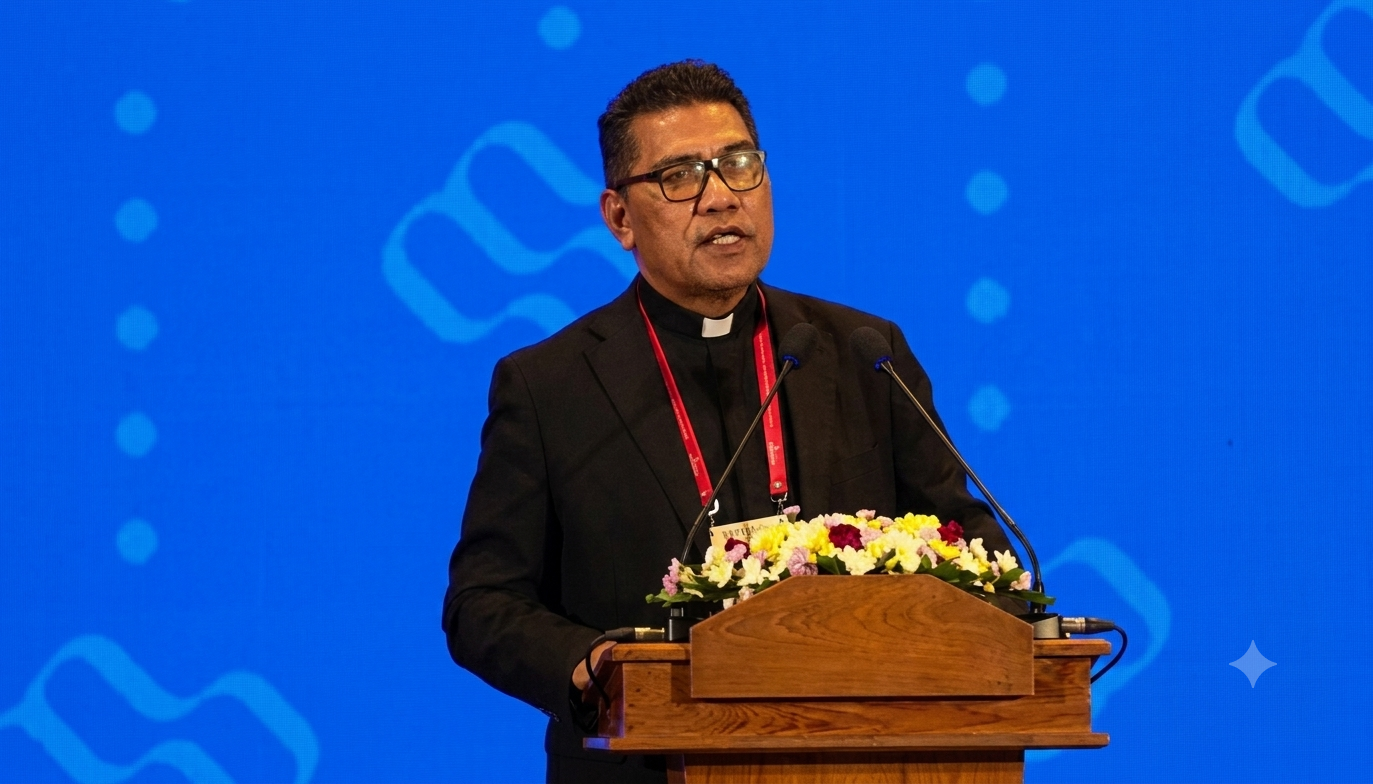
Addressing participants of the 11th World Union of Jesuit Alumni (WUJA XI) at Universitas Sanata Dharma in Yogyakarta on Friday (July 31), the Vatican official argued that interreligious dialogue is not an optional pastoral activity but an indispensable expression of the Church’s very identity and mission.
“The Church is deeply convinced that interreligious dialogue is an authentic and integral element of her mission of evangelization,” said Fr. Markus, who serves at the Dicastery for Interreligious Dialogue in the Vatican.
His presentation, Interreligious Dialogue from a Catholic Perspective: A Noble and Necessary Service for the Good of Humanity, came only moments after Indonesia’s Minister of Religious Affairs, Prof. Dr. KH. Nasaruddin Umar, called on Jesuit alumni worldwide to become builders of dialogue and peace. Together, the two addresses formed a shared appeal: in a world increasingly marked by division, dialogue is no longer a luxury—it is an urgent necessity.
Fr. Markus traced the Church’s understanding of dialogue through history. Before the Second Vatican Council, he explained, Catholic missionary activity was largely shaped by the priorities of establishing the Church and seeking conversions. While many missionaries accomplished remarkable works, encounters with other religions were often framed within the theological assumptions of their time.
That vision changed dramatically with the Second Vatican Council.
Pope John XXIII, responding to the upheavals of the post-war world, called the Council to renew the Church’s engagement with humanity. His successor, Pope Paul VI, developed this vision further through Ecclesiam Suam, emphasizing that the Church must open herself to dialogue with people of other religions, recognize the values present in their traditions, and work together for justice, peace, and human dignity.
At the heart of this renewal stands Nostra Aetate, the landmark declaration on the Church’s relationship with non-Christian religions. Fr. Markus described the document as opening “a new era” in Catholic relations with followers of other faiths—one that continues today through the papacies of St. John Paul II, Benedict XVI, Pope Francis, and now Pope Leo XIV.
He pointed to two milestones that have become symbols of this journey: the Document on Human Fraternity for World Peace and Living Together, signed in Abu Dhabi in 2019 by Pope Francis and the Grand Imam of Al-Azhar, and the Istiqlal Declaration, signed by Pope Francis during his visit to Indonesia, both of which have strengthened global efforts toward peace and interreligious cooperation.
For Fr. Markus, dialogue is much more than formal meetings between religious leaders.
“It is reciprocal communication,” he explained, “an attitude of respect and friendship, and a constructive relationship that fosters mutual understanding while remaining faithful to one’s own beliefs.” The Church, he noted, recognizes four complementary forms of dialogue: the dialogue of life, the dialogue of action, the dialogue of spiritual experience, and theological dialogue.
Those forms of dialogue become especially urgent, he said, because humanity stands at another historic crossroads.
Across the world, hatred is growing. Religious discrimination persists. Nationalism and exclusion continue to undermine trust between communities. The ideals of human fraternity promoted by the Second Vatican Council appear increasingly fragile in many parts of the world.
Yet the Christian response, he insisted, cannot be withdrawal.
Instead, Catholics are called to recognize that God has planted seeds of truth and holiness in other religious traditions. Citing Nostra Aetate, Fr. Markus reminded participants that the Catholic Church “rejects nothing that is true and holy” in other religions and encourages dialogue marked by prudence, charity, and unwavering fidelity to Christian identity.
The ultimate purpose of such dialogue, he continued, is not compromise but conviviality—learning how to live together as brothers and sisters while respecting genuine differences.
Drawing from Pope Francis’ encyclical Fratelli Tutti, he emphasized that humanity shares a common destiny. Dialogue enables people of different faiths to build relationships of trust, preserve their own religious identities, and cooperate in serving society and promoting the common good.
Quoting Pope Francis, Fr. Markus invited participants to expand the ancient Greek maxim “Know yourself” into a broader spiritual imperative: “Know your brother and sister, know their history, their culture and their faith.” Genuine self-understanding, he suggested, is impossible without openness to others.
He concluded by recalling Pope Leo XIV’s recent appeal for “unarmed and disarming peace,” urging Christians to reject violence—not only in armed conflict but also in everyday speech and on social media.
Real peace, he said, begins with each person.
“Our shared responsibility,” Fr. Markus told the audience, “is to take care of ourselves, our neighbors, our young people, and our common home, so that we may leave a more beautiful world for future generations.”
As Jesuit alumni from around the world gathered in Yogyakarta to celebrate the feast of St. Ignatius of Loyola and reflect on leadership in a fractured world, Fr. Markus left them with a challenge that reached beyond the walls of the conference hall.
Interreligious dialogue, he reminded them, is not merely a strategy for coexistence. It is a vocation—a noble and necessary service to humanity, entrusted to believers who dare to build bridges where others continue to erect walls.