

YOGYAKARTA, Indonesia — Education can no longer be satisfied with preparing students merely for future employment. In an era marked by the rapid rise of artificial intelligence (AI), ecological crises, social polarization, and an overwhelming flood of digital information, education must form people capable of discerning what is true, what is good, and how technology can be used in service of a more humane world.
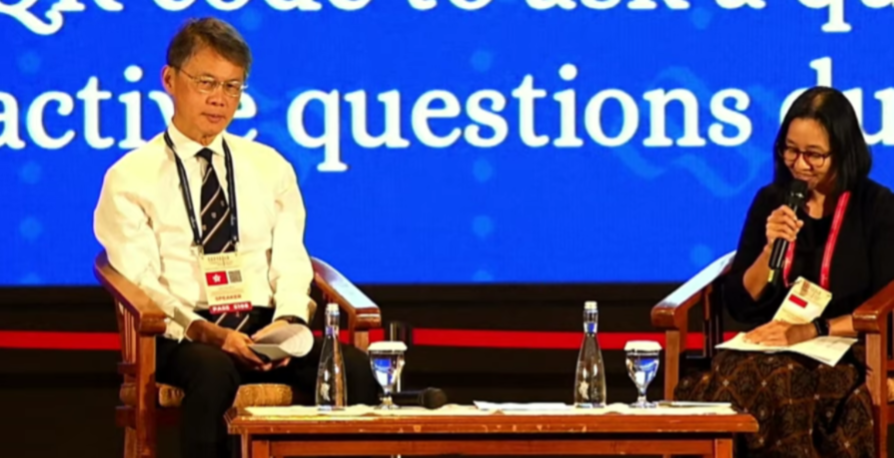
That was the central message delivered by John Tan, an educator from Hong Kong, during his keynote presentation, “Drawing New Map of Hope,” at the Driyarkara Auditorium, Universitas Sanata Dharma, Yogyakarta, on Saturday, August 1, the fourth day of the XI World Union of Jesuit Alumni (WUJA) Congress.
The former Headmaster of Wah Yan College, Kowloon, and Founding Headmaster of Harrow Hong Kong Children School, Shenzhen Qianhai, invited Jesuit alumni from around the world to rethink the very purpose of education in a world changing faster than anyone can predict.
For Tan, the greatest challenge is not technological change itself, but whether educators and Jesuit alumni are willing to accompany young people as companions who help shape their lives rather than simply prepare them for careers.
“If education is to respond to the current and future challenges of the world, we must ask ourselves: what kind of formation do we need to provide, and what kind of companions are we called to become?” he said, introducing the central question of his presentation.
Formation Begins by Listening
Tan grounded his reflection in the Gospel story of Jesus’ journey to Emmaus, describing it not merely as a biblical narrative but as a timeless model of Jesuit pedagogy.
He pointed out that Jesus’ first response to the two disciples was not to teach or correct them, but simply to listen.
Although Jesus already knew what had happened, He invited the disciples to tell their story. This dynamic later became the foundation of what Tan called the Emmaus Pedagogy, an educational approach that has guided Catholic religious and moral education in Hong Kong for more than two decades.
According to Tan, educators today often rush to provide solutions before fully understanding the lived experiences of young people.
Yet today’s students carry anxieties about academic achievement, family expectations, digital life, social pressure, and uncertainty about the future.
For this reason, Jesuit alumni are first called to become attentive listeners.
“Even when we believe we already know the answers, we must first learn to listen,” he emphasized, drawing inspiration from the Emmaus encounter.
Artificial Intelligence Is Reshaping Young People’s Future
Tan identified three major challenges confronting today’s students, beginning with the rapid advancement of artificial intelligence.
AI is now widely used by students to prepare classroom presentations, complete assignments, and design leadership and social service projects. While these tools offer enormous opportunities, they also create new uncertainties.
He referred to developments in Hong Kong, where many university students have begun questioning whether the degrees they are pursuing will still lead to meaningful employment by the time they graduate.
Students are no longer asking only which university to attend; increasingly, they are wondering whether the careers they aspire to will even exist in an AI-driven economy.
For Tan, the issue extends far beyond technology.
It touches the deepest questions of identity, purpose, and hope.
Human Freedom Must Not Be Surrendered to Algorithms
A second challenge, Tan argued, is young people’s growing dependence on social media.
Recalling a school trip during which smartphone usage was restricted, he described how some students experienced severe anxiety, emotional distress, and even physical symptoms when separated from their social media accounts.
Such experiences reveal that the real issue is no longer technology itself, but the gradual loss of interior freedom.
Drawing from Ignatian spirituality, Tan proposed a contemporary interpretation of St. Ignatius’ concept of disordered attachment.
Today’s equivalent, he suggested, could be described as “algorithmic captivity”—a condition in which people’s desires, identity, and self-worth are increasingly shaped by algorithms rather than by genuine freedom.
He encouraged young people to ask themselves a fundamental spiritual question:
“What is shaping my desires? Is it God? Is it myself? Or is it the algorithm?”
For Tan, this question is far more significant than simply keeping pace with the latest technological innovations.
AI Should Help Us Become More Human
Although Tan repeatedly warned about the dangers of AI, he made it equally clear that he does not regard artificial intelligence as an enemy.
During the discussion session following his presentation, he responded to a question from an Indonesian participant about how the Ignatian principle of “Finding God in All Things” can help young people view AI as an opportunity rather than merely a threat.
Tan acknowledged that schools and universities around the world are actively integrating AI into their educational systems and that its positive contributions are already evident.
The real danger, he said, emerges when AI replaces the intellectual growth that students themselves are called to develop.
“If we delegate all our basic thinking to AI from a young age, how will we ever develop the higher-order thinking skills that humanity will need in the future?” he asked. Human intellectual development, he stressed, is a gradual process. Children and young people must exercise the God-given gifts of critical thinking, creativity, leadership, and moral judgment before allowing machines to perform tasks on their behalf.
Finding God Even in Artificial Intelligence
Tan connected this reflection directly to one of the central principles of Ignatian spirituality: Finding God in All Things. He argued that this principle also applies to humanity’s relationship with AI. The essential discernment, he said, is not simply identifying which careers are most resistant to automation, but asking a much deeper question:
“What kind of vocation enables me to become more fully alive as a human person?” Artificial intelligence may generate text, create images, and imitate empathy. But it cannot truly love. Nor does it possess conscience, wisdom, or a soul. Human beings therefore remain uniquely called to offer what technology never can: authentic love, moral wisdom, creativity, compassion, and a living relationship with God.
Ethics Must Accompany Technological Innovation
During the question-and-answer session, Tan also expressed concern that discussions about AI education often emphasize technical competence while giving insufficient attention to ethical formation.
He cited Hong Kong’s recently released AI education blueprint, noting that ethical and moral considerations receive only brief mention without providing educators with concrete guidance on how to teach students to use AI responsibly.
For this reason, he believes Jesuit alumni have an indispensable role to play. They must help younger generations embrace AI positively while remaining aware of its ethical implications, exercising critical judgment rather than accepting AI-generated content uncritically.
“We still have discretion over what AI produces,” he said. “We cannot simply trust everything automatically. We must return to the Ignatian principles and foundations that help us become better human beings and draw closer to God.”
A Mission of Accompaniment
As he concluded his address, John Tan reminded participants that being a Jesuit alumnus means far more than graduating from a Jesuit school. It is a lifelong vocation of accompaniment.
Just as Jesus walked alongside the disciples on the road to Emmaus, Jesuit alumni are called to walk with young people, to listen deeply to their experiences, to help them interpret their lives in the light of the Gospel, and to guide them toward renewed hope amid a rapidly changing world.
For Tan, the future of Jesuit education will ultimately depend not on increasingly sophisticated technologies or constantly changing curricula, but on companions capable of integrating wisdom, discernment, and faith—forming young people who are not only technologically competent but also profoundly human, compassionate, and committed to serving others.