


YOGYAKARTA, Indonesia — Humanity has never possessed as much information as it does today. Every second, billions of messages, images, videos, and data points circulate across digital platforms, while artificial intelligence processes information at a speed unimaginable only a decade ago. Yet paradoxically, the explosion of information has not produced greater certainty. Instead, it has left people increasingly confused, polarized, and uncertain about whom—and even what—to trust.
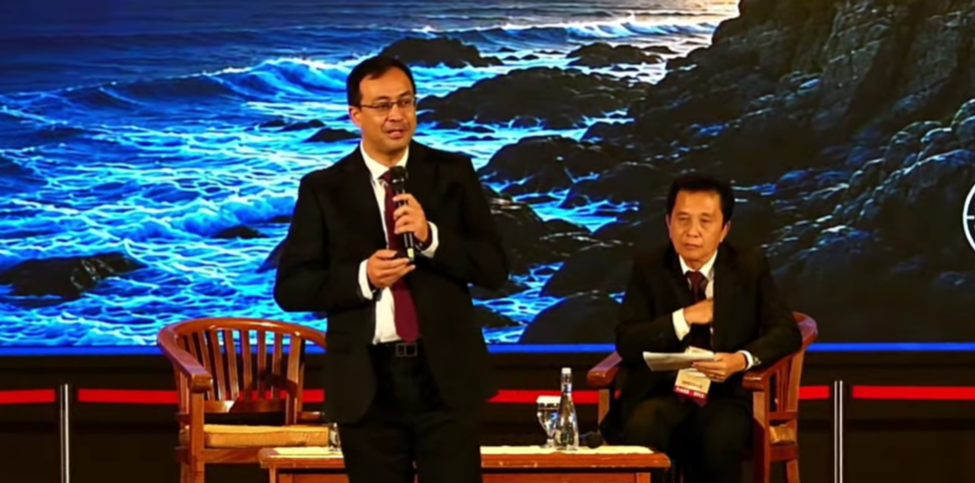
That paradox was at the heart of a keynote address by Martianus Ezerman, Senior Lecturer in the Division of Mathematical Sciences at Nanyang Technological University (NTU), Singapore, during the 11th World Union of Jesuit Alumni (WUJA XI) on Saturday, August 1, 2026, at the Driyarkara Auditorium, Universitas Sanata Dharma, Yogyakarta. Speaking on “Discernment in the Age of Unanchored Information: How Technology Reshapes Conscience, Identity, and Discernment, Promoting Integrity in the Digital Public Sphere,“ Ezerman argued that while technology has transformed the way humanity communicates, the deepest challenge of the digital age is no longer technical—it is profoundly human.
Introduced by moderator Dr. Johanes Eka Priyatma, who reflected on the opportunities and anxieties created by artificial intelligence, Ezerman invited participants to move beyond debates about whether technology is good or bad. The more pressing question, he suggested, is whether humanity is developing the wisdom necessary to use increasingly powerful technologies responsibly. Eka noted that digital technologies make information easier than ever to create, distribute, and manipulate, making the search for truth and the cultivation of trust among the defining challenges of the present era.
Ezerman began with a striking observation.
Never before in history has humanity produced so much information. The amount of data generated every single day now exceeds what entire civilizations created over centuries. Conventional wisdom would suggest that more information should reduce uncertainty and improve decision-making. Instead, the opposite appears to be happening.
“We have more information,” he observed, “but we trust one another less.”
Even more troubling, he added, many people increasingly distrust themselves. Artificial intelligence, while offering extraordinary capabilities, has also accelerated the spread of misinformation, deepfakes, manipulated content, and false narratives. The ease with which convincing fake images and videos can now be produced has fundamentally altered the relationship between information and truth.
The digital revolution, he argued, has therefore created a paradox.
Humanity enjoys unprecedented connectivity, yet societies have become more polarized. Communication is instantaneous, but genuine understanding appears increasingly elusive. Information has become abundant, while confidence in institutions, media, and even personal judgment continues to erode.
Drawing from more than two decades of research in coding theory, cryptography, and cybersecurity, Ezerman explained that modern digital systems are designed to establish trust. Mathematical models detect and correct errors, encryption protects confidentiality, authentication verifies identities, and cybersecurity safeguards digital transactions.
Every online banking transaction, for example, depends upon sophisticated mathematical systems that verify both the identity of the user and the authenticity of the institution while preserving the integrity of financial transactions. Most users rarely notice these invisible layers of protection because they function quietly in the background of daily life.
Yet technical excellence alone cannot guarantee trustworthy digital societies.
“The mathematics may be difficult,” Ezerman remarked, “but the human aspects should terrify you.”
Cybersecurity, he explained, is ultimately not only about algorithms but also about judgment. Engineers must constantly balance competing priorities such as speed, accessibility, affordability, and security. Every technical decision reflects human values, ethical choices, and practical trade-offs rather than mathematical calculations alone.
To illustrate how rapidly artificial intelligence is reshaping education, Ezerman recounted the experience of Professor Roberto Serrano of Brown University.
Following a campus shooting, Serrano replaced a traditional in-class midterm examination with an extended take-home assessment that allowed students to use any available resources. The results appeared extraordinary, with most students achieving exceptionally high scores.
But when the professor later restored a supervised, handwritten final examination weighted far more heavily, performance collapsed dramatically. Many students withdrew, failed to appear, or earned significantly lower marks.
Rather than blaming students for laziness, Ezerman challenged educators to confront a more uncomfortable reality.
“If we place students in temptation,” he suggested, “why are we surprised when they use AI?”
Students, he argued, naturally seek every available advantage, just as educators themselves increasingly rely on artificial intelligence. The deeper issue is not technology itself but whether educational systems are measuring the kinds of human capacities that AI cannot replace—critical judgment, discernment, creativity, and ethical reasoning.
That changing landscape is also transforming the AI industry itself.
Technology companies are now recruiting philosophers, historians, psychologists, anthropologists, and other humanities graduates because many of the hardest AI problems are no longer computational. Modern algorithms have become increasingly capable of processing vast quantities of data. What remains difficult is asking the right questions, interpreting complex human realities, and understanding values, meaning, and social context.
“The hardest AI problems,” Ezerman explained, “are increasingly human problems.”
The same insight applies to cybersecurity.
Contrary to popular imagination, sophisticated hackers rarely begin by attacking computer systems directly. Instead, they target human beings.
Phishing scams, fraudulent emails, fake government messages, romance scams, and impersonation schemes all exploit trust, loneliness, fear, or haste rather than weaknesses in computer code.
Drawing examples from both Indonesia and Singapore, Ezerman described how cybercriminals often wait patiently for expired security contracts, exploit careless use of public Wi-Fi, impersonate government officials, or manipulate emotionally vulnerable individuals into voluntarily surrendering money or sensitive information.
“The best hackers,” he observed, “do not attack systems. They attack judgment.”
The most effective response, therefore, is not always stronger technology.
Banks in Singapore, he explained, increasingly introduce mandatory waiting periods before allowing transfers to newly added recipients. Financial institutions also delay suspicious transactions and require additional verification before releasing funds.
These measures intentionally slow decision-making, giving customers time to reconsider impulsive actions triggered by fear or manipulation.
Technology, in other words, is being redesigned to protect human judgment rather than simply accelerate transactions.
Returning to the broader implications of artificial intelligence, Ezerman argued that AI does not fundamentally change human nature.
Instead, it amplifies what already exists.
It magnifies both generosity and deception, creativity and manipulation, wisdom and misinformation. Powerful digital tools can automate cyberattacks, but they can also strengthen digital defenses. Whether they ultimately benefit society depends less on technology itself than on the people who design, regulate, and use it.
For that reason, discernment has become one of the defining virtues of the digital age.
Societies need stronger ethical frameworks, more responsible leadership, and renewed attention to human dignity, especially in protecting the poor and marginalized who are often the most vulnerable to digital exploitation. Access to secure technologies, he argued, should become more affordable, inclusive, and equitable rather than remaining a privilege available only to a few.
Ezerman concluded by recalling one of the foundational insights of communication theory developed by Claude Shannon: every communication channel contains noise.
In human life, that “noise” takes many forms—misunderstanding, fear, assumptions, prejudice, unrealistic expectations, and emotional reactions. Technology can reduce certain kinds of noise, but it cannot eliminate those rooted in the human condition.
Technical solutions, he emphasized, will always require wise human judgment.
In an age overflowing with information yet increasingly detached from certainty, the future of trustworthy digital societies will depend not simply on smarter machines, but on wiser human beings capable of discerning truth, exercising ethical responsibility, and preserving integrity in the digital public sphere.