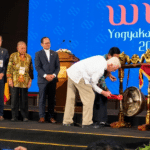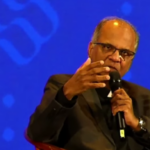


YOGYAKARTA — There would be no time for a siesta that afternoon. Delegates filled the conference hall promptly for the first session after lunch, setting aside the familiar midday pause to continue reflecting on the theme of the congress, “United in Spirit, Leading with Purpose.”
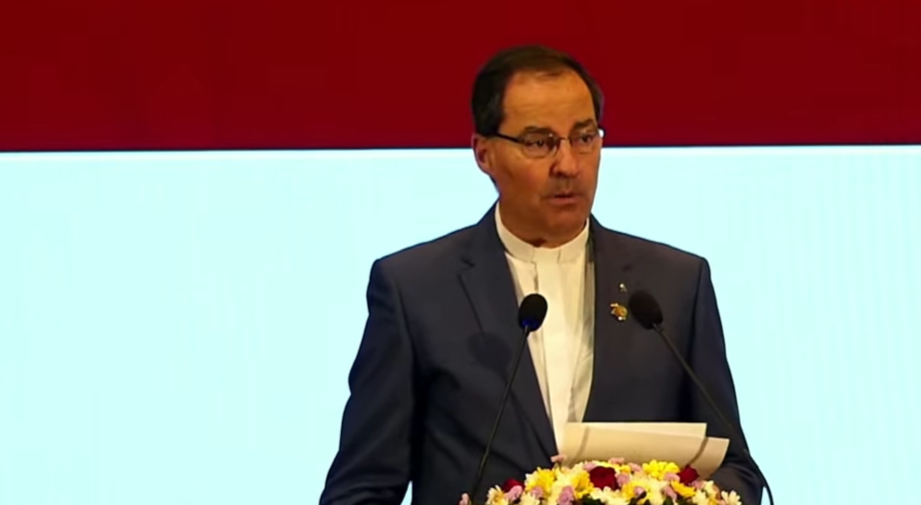
The session focused on the shared mission of Jesuit education and featured two global leaders of the Society of Jesus’ educational apostolate. The first speaker was Fr. Jimmy Bartolo, SJ, Secretary for Secondary and Pre-Secondary Education at the Jesuit Curia in Rome, followed by Fr. Joseph Christie, SJ, Secretary for Higher Education.
Introducing the session, the moderator briefly outlined Fr. Jimmy Bartolo’s journey before assuming one of the Society’s most significant educational leadership roles. On November 9, 2024, Superior General Fr. Arturo Sosa, SJ, appointed the Jesuit from the Europe and Catalonia Province as Secretary for Secondary and Pre-Secondary Education, succeeding Fr. José Mesa, SJ, who had served in the position for fifteen years. Fr. Jimmy officially began his mandate in January 2025.
His appointment brought decades of educational experience to the Secretariat. Fr. Jimmy previously served as Director of St. Aloysius College in Malta for eleven years and as Education Delegate of his province for five years. His academic formation includes studies in philosophy at the Alessandrino in Padua, theology at the Milltown Institute in Dublin and Comillas Pontifical University in Madrid, as well as a Master’s degree in Educational Leadership from Boston College. Together, these experiences have prepared him to oversee one of the world’s largest Catholic educational networks.
Opening his presentation, Fr. Jimmy expressed his gratitude for the opportunity to be in Yogyakarta. He thanked WUJA, the Indonesian hosts, and Universitas Sanata Dharma for organizing the 11th Congress and for inviting him to share the mission of Jesuit secondary and pre-secondary education. For him, the twenty-minute presentation was not merely an institutional report but an opportunity to illustrate how the Society of Jesus is living out its educational mission across the globe.
He immediately connected his remarks with the address delivered earlier that morning by Fr. Arturo Sosa. The congress theme, “United in Spirit, Leading with Purpose,” he said, should not be understood simply as an inspiring slogan. Rather, it is both an invitation and a challenge for Jesuit alumni to become companions in the mission of reconciliation and justice.
Fr. Jimmy reminded participants that alumni are called to be far more than former students who cherish memories of the schools they once attended. Instead, they are invited to allow the Holy Spirit to unite them as members of one body, sharing one common mission. Every educational ministry of the Society of Jesus, he emphasized, must be understood within this broader ecclesial calling.
To explain how that mission is carried out today, Fr. Jimmy outlined four key areas that would guide his presentation. First, he would reflect on the mission entrusted by the Church to the Society of Jesus. Second, he would explain how the Secretariat operates through the Society’s six regional conferences and the Jesuit Global Network of Schools, including Fe y Alegría and the Jesuit Refugee Service (JRS), both integral parts of Jesuit education. Third, he would share developments and initiatives undertaken during the past six months. Finally, he would invite young Jesuit leaders to participate in MAGIS 2027.
Spiritual Exercises: The Foundation of Every Jesuit Ministry
One of the strongest themes throughout Fr. Jimmy’s presentation was that Jesuit education cannot be separated from the spiritual life.
Recalling Fr. Arturo Sosa’s keynote address, he reminded participants that when Pope Francis entrusted the Society of Jesus with the Universal Apostolic Preferences (UAPs) in 2019, the order of those priorities was deliberate and deeply significant.
The first preference—showing the way to God through the Spiritual Exercises and discernment—is not simply one among four priorities. Rather, it is the foundation upon which every other apostolic work rests. Without a life rooted in prayer and discernment, educational, pastoral, and social ministries cannot truly bear fruit.
For that reason, Fr. Jimmy echoed the Superior General’s invitation for everyone attending the congress to undertake the Spiritual Exercises of St. Ignatius, in whatever form they are available. Those who feel called are also encouraged to be trained as retreat guides so that the gift of Ignatian spirituality may continue to spread throughout the Church.
He stressed that this invitation should not be regarded as a simple spiritual recommendation. Rather, it is a clear appeal from the Superior General to every Jesuit alumnus and alumna.
“Please do feel free to do these Spiritual Exercises. It is what unites us,” he said.
Fr. Jimmy expressed his conviction that if participants were to leave the congress having made just one important decision—to seek spiritual accompaniment and undertake the Spiritual Exercises—they would return home with much deeper spiritual roots for their common mission.
He also emphasized that the Spiritual Exercises are not the exclusive property of the Society of Jesus. Lay people, diocesan priests, and members of other religious congregations can also become qualified spiritual guides. What truly matters is the encounter with God that becomes the foundation of every apostolic mission.
Drawing on the example of St. Ignatius Loyola, Fr. Jimmy recalled how the founder of the Jesuits accompanied people from every walk of life. He guided the poor, the wealthy, and those in positions of authority with equal freedom, helping each discern God’s will. That same openness, he said, should continue to shape Jesuit education today.
He concluded this section with a simple yet powerful encouragement:
“Take the leap. Do not be afraid.”
Jesuit Education Faces a New Frontier: Artificial Intelligence
Fr. Jimmy then turned to one of the defining challenges confronting Jesuit education today.
He recalled that during Pope Leo XIV’s meeting with the Society’s Major Superiors last October, the Holy Father reaffirmed the Jesuits’ mission to remain present on the frontiers of human experience—not only geographical, cultural, intellectual, and spiritual frontiers, but increasingly the frontier of technology, particularly Artificial Intelligence (AI).
For that reason, he argued, Jesuit schools cannot afford to treat AI as a peripheral issue. Instead, classrooms have become the very places where future generations will either learn to use these technologies responsibly or fall into their misuse.
“This is not an abstract mandate for our schools,” he explained. “It is our daily work. Our classrooms are precisely where the next generation will learn to use—or resist the misuse of—these technologies.”
Artificial intelligence, he noted, is already reshaping education at every level, from primary schools to universities. Nearly everyone now uses AI in one form or another, making it inevitable that teaching and learning will change dramatically in the years ahead. Yet the central challenge is not merely technological adaptation; it is the formation of ethically responsible human beings capable of using these tools in accordance with the Church’s social teaching.
For Fr. Jimmy, Jesuit education must continue to be measured not simply by academic achievement but by human formation.
Quoting Fr. Arturo Sosa’s reflections from earlier in the day, he reminded participants that Jesuit schools have never been judged primarily by what students know, but rather by who they become.
In an age increasingly shaped by artificial intelligence, that vision of integral formation, he suggested, is more relevant than ever.
Forming Men and Women for the Digital Age
Building on that vision, Fr. Jimmy revisited a concept that has long been central to Jesuit education—the Four Cs introduced by former Superior General Fr. Peter-Hans Kolvenbach: competence, conscience, compassion, and commitment. Yet, he explained, these four pillars must now be interpreted in light of the Society’s contemporary mission and the realities of the digital age.
Competence today can no longer be understood solely as academic excellence. It must also include digital literacy and the ability to use emerging technologies responsibly. Conscience must extend beyond personal morality into the digital sphere, where ethical discernment is increasingly required. Compassion should embrace those who remain excluded by the widening digital divide, while commitment must inspire students to advocate for the ethical governance of artificial intelligence and the digital world.
According to Fr. Jimmy, these are no longer theoretical concerns. They define one of the most important frontiers where Jesuit schools are called to serve today, shaping not only educational priorities but also the formation of future leaders capable of responding to rapidly changing global realities.
A Global Educational Mission Across 80 Countries
Fr. Jimmy then turned to the remarkable scale of the Society of Jesus’ educational apostolate, illustrating how Jesuit education has become one of the largest international Catholic educational networks in the world.
Through the six Jesuit Conferences and in partnership with Fe y Alegría and the Jesuit Refugee Service (JRS), the Jesuit Global Network of Schools is now present in 80 countries, operating 2,781 formal schools that serve approximately 1.87 million students. This vast network is supported by more than 100,000 lay educators working alongside 1,757 Jesuits, all united by a common educational mission.
When informal education initiatives led primarily by Fe y Alegría and JRS are included, the network expands even further. Altogether, Jesuit education reaches 3,450 schools and educational projects, serving more than 2.15 million students and beneficiaries around the world. Although spread across different continents, languages, and cultures, Fr. Jimmy emphasized that these institutions share one common purpose and one educational vision.
Supporting Six Regional Networks
Explaining how such a vast educational network is coordinated, Fr. Jimmy described the organizational structure of the Secretariat for Secondary and Pre-Secondary Education.
Rather than directing schools individually, the Secretariat works closely with six regional coordinators, each representing one of the Society’s global conferences. Among them is Fr. Koko, who serves as the coordinator for the Asia-Pacific Conference.
Fr. Jimmy explained that his principal responsibility is to accompany and support these regional coordinators, education delegates, and provincial delegates in implementing educational priorities and apostolic planning. The Secretariat also collaborates closely with Fe y Alegría and the Jesuit Refugee Service, ensuring that schools across the world remain connected through a common mission while responding to local realities.
Beyond its organizational structure, the global network is increasingly strengthened through Educate Magis, an online platform that allows Jesuit educators across continents to collaborate, exchange ideas, and learn from one another. Fr. Jimmy described it as a large virtual community that embodies the global dimension of Jesuit education.
Regional Networks Reflect Diverse Realities
Fr. Jimmy then offered a closer look at the Society’s six regional educational networks, illustrating both their diversity and their common mission.
The Asia-Pacific Conference, where the congress was being held, represents the smallest regional network, comprising 47 schools served by 120 Jesuits. He recalled a recent gathering in Hong Kong where education delegates met to discuss apostolic planning and the implementation of shared priorities throughout the region.
The Africa Conference has become one of the fastest-growing regions in the Society, both in terms of vocations and educational development. The network currently includes 60 schools and 114 Jesuits, reflecting the rapid expansion of Jesuit educational ministry across the continent.
In North America, represented by the Jesuit Schools Network (JSN), Fr. Jimmy highlighted a different reality. Although the network includes 90 schools and 197 Jesuits, leadership increasingly rests in the hands of highly qualified lay professionals. This growing participation of lay collaborators has become one of the defining characteristics of Jesuit education in the region.
A similar pattern can be seen across Europe, where the Society oversees approximately 290 schools. Despite the declining number of Jesuits, the educational mission continues to flourish through extensive collaboration with lay educators and companion schools, demonstrating that the Ignatian tradition can thrive through shared leadership.
The largest educational network, however, is found in South Asia, particularly India, where the Society operates 419 schools with the support of 811 Jesuits serving across the country’s twenty Jesuit provinces. Smiling as he presented the figures, Fr. Jimmy observed that nearly half of the Society’s schools are located there, prompting appreciative reactions from the audience.
Reaching the Margins Through Fe y Alegría
After outlining the global structure of Jesuit education, Fr. Jimmy shifted the audience’s attention to one of the Society’s most significant educational ministries among the poor: Fe y Alegría.
He described the movement as far more than another educational network. Founded in Venezuela by Jesuit priest Fr. José María Vélaz, Fe y Alegría was established to bring quality education to communities that conventional public and private school systems often fail to reach. Operating primarily with public funding, the network serves children in remote rural communities and marginalized urban areas where educational opportunities remain scarce.
For the Society of Jesus, Fr. Jimmy stressed, Fe y Alegría occupies a unique and indispensable place within its educational mission.
Today, the movement has expanded to approximately 1,770 schools, making it one of the largest Catholic educational initiatives serving disadvantaged communities. Although many of its schools are considerably smaller than well-known Jesuit institutions such as Canisius, De Britto, Gonzaga, or Loyola, their significance lies not in their size but in their ability to reach those who would otherwise be left without access to education.
Remarkably, this extensive network is supported by only 51 Jesuits, working alongside thousands of lay collaborators who share the Society’s commitment to educational justice. Fr. Jimmy recalled the movement’s most recent international assembly in Guatemala, where educators gathered to strengthen their common mission and renew their commitment to serving the poor.
While Fe y Alegría remains deeply rooted in Latin America, it has expanded steadily into Africa, and is now present in parts of Asia, including Cambodia and Nepal. Its continued growth, Fr. Jimmy noted, reflects the Society’s determination to ensure that quality education reaches the world’s most vulnerable communities.
Education as a Lifeline for Refugees
Fr. Jimmy then turned to another apostolic priority that has become increasingly urgent in today’s world: the education of refugees and migrants.
Referring to Fr. Arturo Sosa’s earlier address to young delegates, he recalled how the Superior General had challenged them to accompany displaced people whose lives have been disrupted by war, violence, persecution, and forced migration. For Fr. Jimmy, this was not merely another apostolic recommendation—it was a direct appeal that touches the heart of Jesuit identity.
He shared one of his earliest conversations with Fr. Arturo after beginning his mandate in Rome. The Superior General invited him to notice a large painting displayed outside his office, portraying a refugee mother carrying her child. The image, Fr. Jimmy said, became a lasting symbol of the Society’s educational mission.
Fr. Arturo then recounted words spoken to him during a visit to a refugee camp—words that Fr. Jimmy admitted had deeply moved him.
“Father, our lives are already difficult. We already experience poverty. Please do not take education away from us, because then you will make us even poorer.”
For Fr. Jimmy, that simple plea captures the essence of the Society’s educational vocation. Education is not an optional service offered only when circumstances permit. It is a source of dignity, hope, and human development that becomes even more essential amid displacement and suffering.
“This is our mission,” he said, echoing the Superior General’s conviction. “Accompany these people.”
He encouraged the young alumni gathered in Yogyakarta to remain attentive to God’s call. If they sense an invitation to serve refugees and migrants, they should not hesitate to respond. The need is immense—not only within refugee camps but also in educational centers where displaced children and young people are given an opportunity to rebuild their futures through learning.
As Fr. Jimmy observed, forced migration has become one of the defining realities of the twenty-first century. For that reason, the Society’s commitment to refugee education will only grow in importance.
Within the Jesuit Refugee Service (JRS), education already represents the core of its global ministry. Of the organization’s 67 projects worldwide, 57 focus primarily on education, providing learning opportunities to approximately 534,000 refugees and displaced persons. Those figures, Fr. Jimmy suggested, demonstrate that the Society’s response to migration is not merely humanitarian but profoundly educational, empowering people to reclaim hope through knowledge and formation.
Discernment Shapes the Future of Jesuit Education
Having presented the Society’s major educational ministries, Fr. Jimmy moved to what he described as the discernment process currently guiding the International Commission on the Apostolate of Jesuit Education (ICAJE) and the Jesuit Global Network of Schools.
Rather than imposing priorities from the center, the Secretariat began by listening carefully to educational leaders from every region of the world. During ICAJE’s meeting in May, representatives from the six Jesuit Conferences were invited to share the realities they face, the apostolic priorities they have identified, and the challenges confronting their schools.
The conversations revealed remarkable convergence. Despite serving vastly different cultural, economic, and political contexts, the regions consistently identified similar concerns and aspirations. For Fr. Jimmy, this common direction was more than organizational agreement—it was evidence of the Holy Spirit guiding the Society toward shared priorities.
Out of that discernment emerged three principal areas that will shape Jesuit education in the years ahead.
The first is the formation of leaders, with particular emphasis on cultivating discernment. Leadership in Jesuit schools, Fr. Jimmy explained, cannot be reduced to administrative competence or managerial skills. It must be rooted in the Ignatian capacity to listen, reflect, pray, and make decisions guided by the Spirit.
The second priority is educating students who transform reality.
Fr. Jimmy challenged the tendency to measure educational success solely by examination scores, prestigious university placements, or academic rankings. While intellectual excellence remains an essential characteristic of Jesuit education, it is never its ultimate goal.
“We do not simply want students who earn excellent degrees and proudly celebrate being at the top of their class,” he explained. “That is only part of a Jesuit education.”
He was careful to clarify that this vision should not be interpreted as anti-intellectual. On the contrary, he reaffirmed the Society of Jesus’ historic commitment to the intellectual apostolate. Academic excellence remains indispensable, but it must always be directed toward service.
For Fr. Jimmy, the true measure of Jesuit education lies in whether graduates become leaders capable of transforming society, particularly by improving the lives of the poor and addressing injustice. Knowledge acquires its deepest meaning only when it becomes an instrument of social transformation.
The third priority focuses on building more inclusive schools.
While acknowledging that many Jesuit institutions already embody this commitment, Fr. Jimmy admitted that the Society still faces important challenges. Some schools continue to serve predominantly affluent families or admit only the highest-achieving students.
“We need to do something about that,” he said candidly.
For Jesuit education to remain faithful to its mission, schools must become communities where diversity is welcomed and opportunities are extended beyond the privileged few. Inclusivity, he suggested, is not simply an educational strategy but an expression of the Gospel itself.
Strengthening a Worldwide Educational Community
Fr. Jimmy went on to explain that the global network is sustained not only through regional coordination but also through regular international gatherings that strengthen collaboration among educators across continents.
These meetings are held every three years and have become important milestones in building a truly global educational community. Previous gatherings have taken place in Boston and Rio de Janeiro, bringing together education delegates from around the world to reflect on their common mission and exchange experiences from their respective regions.
The next major international meeting is already being prepared in Montreal, where delegates will once again gather to discern future priorities and deepen cooperation throughout the worldwide network.
For Fr. Jimmy, such encounters are far more than administrative meetings. They reinforce the conviction that, although Jesuit schools operate in diverse political, cultural, and economic settings, they remain part of a single apostolic body united by a common educational vision.
Measuring Impact Through Research and Collaboration
Looking toward the future, Fr. Jimmy introduced several global initiatives that the Secretariat has recently launched to strengthen Jesuit education.
One of the most significant is a comprehensive global survey designed to evaluate how effectively Jesuit schools are implementing their shared vision. Rather than relying on assumptions or anecdotal evidence, the initiative seeks to generate scientific and evidence-based data that will help guide future planning.
The Society already possesses vision statements, policy documents, and action plans, he noted. The pressing question now is whether those commitments are actually being translated into practice.
“What are we doing? What are we implementing?” he asked. “Let us be honest about where we are today and where we want to go.”
The survey therefore serves not merely as an evaluation tool but as an exercise in communal discernment, enabling the Society to identify both its strengths and the areas requiring further development.
At the same time, the Secretariat is reviewing and strengthening the role of provincial education delegates, recognizing that effective leadership at the local level remains essential for the vitality of the global network.
Artificial Intelligence as a Shared Global Priority
Among the Secretariat’s newest initiatives, none reflects the changing educational landscape more clearly than its work on Artificial Intelligence.
Fr. Jimmy explained that the Society has established an international working group composed of representatives from all six Jesuit Conferences, together with members of Fe y Alegría and the Jesuit Refugee Service. Bringing together educators from every region ensures that the conversation on AI is not confined to a single country or educational system but benefits from diverse experiences across the global network.
The group’s work is organized around three principal objectives.
The first is to conduct research and gather documentation on both the opportunities and the challenges that artificial intelligence presents for Jesuit schools. Rather than reacting to technological developments after they occur, the Society aims to understand AI critically and proactively, exploring how it can enhance learning while safeguarding the ethical values central to Jesuit education.
The second objective is to foster a global dialogue among educators. Fr. Jimmy emphasized that schools should not confront these unprecedented challenges in isolation. Instead, teachers, administrators, and educational leaders are encouraged to learn from one another, exchange experiences, and build an international community capable of discerning together the implications of emerging technologies.
The third objective is to provide long-term direction and continuity for Jesuit secondary education. Artificial intelligence is not viewed as a passing trend but as a transformation that will permanently reshape education. Consequently, the Society intends to develop strategic responses that will enable Jesuit schools to remain faithful to their mission while embracing innovation responsibly.
For Fr. Jimmy, this collaborative approach reflects the very nature of Jesuit education. No province, school, or region possesses all the answers. Progress depends on listening to one another, sharing knowledge, and discerning together how technology can be placed at the service of humanity rather than allowed to dominate it.
Learning Globally, Acting Locally
Another initiative that Fr. Jimmy highlighted seeks to transform the way students understand their place in an increasingly interconnected world.
Known as Educating for Global Collaboration, the program connects students from Jesuit schools across different countries without requiring large budgets or extensive travel. Through virtual collaboration, young people from diverse cultures meet online to examine common challenges, exchange perspectives, and reflect together on issues affecting their communities.
Yet the purpose extends beyond conversation.
Once students have explored a global issue collectively, each group is encouraged to return to its own local context and translate those insights into concrete action. The guiding principle is simple: think globally, act locally.
Fr. Jimmy illustrated this with practical examples. Solutions that may prove effective in Calcutta cannot simply be transplanted to Malta. Likewise, educational responses developed in Washington may not be appropriate for Abuja. Every community faces unique social, cultural, and economic realities, requiring local creativity while remaining connected to a broader global vision.
This approach, he explained, allows students to appreciate both the universality and the diversity of the Jesuit mission. They learn to see themselves as members of a worldwide community while recognizing their responsibility to serve the particular needs of their own societies.
The initiative has already gained considerable momentum. At present, 22 collaborative groups, including participants from China, are actively engaged in the program, demonstrating how digital connectivity can strengthen global solidarity without erasing local identity.
An Invitation to MAGIS 2027
As his presentation drew toward its conclusion, Fr. Jimmy returned to the challenge that Fr. Arturo Sosa had posed to participants at the opening of the congress.
The Superior General, he recalled, had urged alumni not to leave the gathering inspired merely by ideas or aspirations. Instead, they should return home with concrete and achievable commitments—practical steps that could be implemented within their own communities, institutions, and apostolic ministries.
Fr. Jimmy expressed his hope that his presentation had offered precisely that kind of practical vision.
Rather than presenting an abstract philosophy of Jesuit education, he had sought to reveal the reality of a worldwide apostolic body comprising nearly 3,000 schools and educational projects, serving more than two million students and beneficiaries through a series of concrete initiatives focused on discernment, artificial intelligence, global collaboration, leadership formation, and youth engagement.
These initiatives, he said, represent practical ways of embodying in classrooms across six continents the mission articulated by the Superior General earlier that day.
Turning his attention especially to the younger participants in the congress, Fr. Jimmy extended a personal invitation to become involved in MAGIS 2027.
The program, he explained, is not intended for everyone indiscriminately. Interested young leaders are encouraged first to speak with their provincial education delegates and youth ministry delegates, who will oversee the selection process within each country.
Approximately 2,000 young leaders from around the world are expected to gather in Korea for the Ignatian formation program preceding World Youth Day. This Ignatian experience will then be followed by participation in the international celebration with the Holy Father.
Fr. Jimmy described MAGIS not simply as another international event but as an opportunity to form a new generation of Ignatian leaders capable of serving both the Church and society.
Walking Together in One Mission
In his final remarks, Fr. Jimmy returned once more to the central message of the congress and the words of the Superior General.
The Society’s work with young people, he said, rests on three essential dimensions: helping them discern their vocation, cultivating sensitivity toward others, and nurturing authentic community life. These priorities are inseparable from the broader mission of Jesuit education, which seeks not merely to educate individuals but to form companions committed to serving the Gospel together.
He concluded by repeating Fr. Arturo Sosa’s words, allowing them to serve as both a summary of his presentation and a commissioning for everyone present:
“We are companions in the deepest sense. We share the same bread. We walk the same path. We serve the same Lord.”
With those words, Fr. Jimmy brought his address to a close, leaving delegates with a vision of Jesuit education that extends far beyond classrooms and academic achievement—a global mission rooted in discernment, committed to justice, open to technological change, attentive to the poor, and united in forming leaders who will build a more compassionate and reconciled world.