

YOGYAKARTA, Indonesia – On the second day of the 11th World Union of Jesuit Alumni (WUJA XI) Congress, held at the Driyarkara Auditorium of Sanata Dharma University, Yogyakarta, on Thursday, July 30, 2026, delegates were invited to reflect on a question that became the central thread of the entire congress: Who are we as Jesuit alumni? More than a philosophical inquiry, the question was presented as the starting point for building a stronger, more purposeful global movement of Jesuit alumni in service to the Church and society.
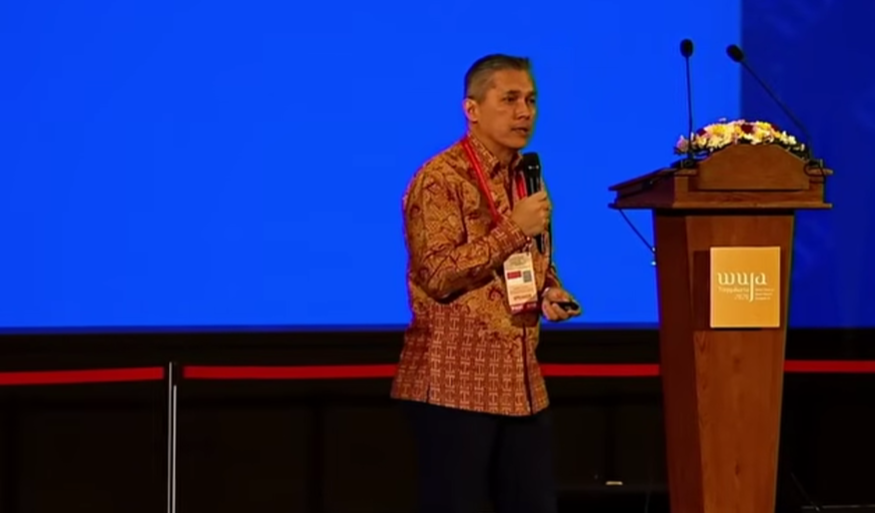
The vision was presented by George Pramadono, a member of the WUJA XI Steering Committee and Vice President of the World Union of Jesuit Alumni (WUJA). In his presentation, he outlined the philosophy, extensive preparation, and strategic direction behind the international gathering. After nearly two years of preparation, he said, the Indonesian organizing committee wanted the congress to become much more than a reunion or networking event, but rather a milestone that would lay a new foundation for the global Jesuit alumni movement.
Held under the theme “United in Spirit, Leading with Purpose,” the congress brought together approximately 1,052 participants from 30 countries, including 121 youth delegates, and featured 15 international speakers over five days. Indonesia, as the host nation, had the largest delegation, followed by India, the Philippines, and participants from Latin America, Europe, Africa, and other regions around the world.
George explained that from the outset, the organizing committee envisioned WUJA XI as far more than an international reunion of Jesuit alumni. The congress was designed to strengthen global networking, deepen alumni participation in the mission of the Society of Jesus, and translate the values of Jesuit education into concrete action for the common good.
He noted that WUJA XI also builds upon the previous congress in Barcelona while responding to Superior General Father Arturo Sosa, SJ’s call for Jesuit alumni to become active partners in the Society’s shared mission.
Yet George stressed that none of these aspirations can be achieved without strong and mature alumni organizations.
Today, the Jesuit educational network includes approximately 850 schools and 250 universities worldwide. However, many of these institutions still lack active alumni associations, while some have none at all.
For this reason, he argued that one of WUJA’s major priorities in the coming years should be helping establish and strengthen mature alumni organizations throughout the world.
He emphasized that the development of alumni organizations is a shared responsibility involving alumni themselves, educational institutions, and the Society of Jesus. Alumni must sustain their own organizations, schools should continue accompanying graduates beyond graduation, and Jesuits should remain active partners in nurturing alumni communities.
As an example, George cited the experience of the Canisius College Jakarta Alumni Association, which was given a dedicated clubhouse on campus. Although seemingly modest, that space has become the foundation for decades of collaboration and alumni initiatives.
Beyond organizational development, George said there remains a fundamental question that has never been fully answered.
Why do Jesuit alumni travel thousands of miles simply to gather together?
What truly binds them across cultures, languages, and continents?
According to him, answering these questions will shape the future direction of WUJA.
The guiding question—“Who are we as Jesuit alumni?”—became the heart of the congress.
From that reflection emerged the initiative to develop the Jesuit Alumni Identity Manifesto, a shared declaration intended not only to define who Jesuit alumni are, but also how Ignatian values are lived out through service and leadership in today’s world.
To prepare the manifesto, the organizing committee undertook an extensive global consultation well before the congress.
Through two rounds of Pre-Congress meetings, organizers held online consultations with alumni federations across different regions of the world. Participants were invited to identify their greatest concerns, propose discussion topics, and even recommend speakers for the congress.
Thousands of Jesuit alumni also completed surveys exploring both alumni identity and the challenges facing alumni organizations in their respective countries. The findings became the basis for shaping the congress agenda and discussions.
The first global survey, involving respondents from 34 countries, found that corruption and weak integrity were the most pressing social concerns shared by Jesuit alumni worldwide.
Respondents also identified economic instability, challenges to democracy, and other social issues as major concerns.
At the same time, alumni organizations expressed pride in their social outreach, educational initiatives, advocacy work, and lifelong formation programs.
Nevertheless, many acknowledged that sustaining membership—particularly attracting and engaging younger alumni—remains one of their greatest challenges.
The second survey, devoted specifically to Jesuit alumni identity, gathered 4,123 responses from 43 countries.
Its findings revealed remarkable consistency in the values shared by Jesuit alumni across the globe.
Honesty and integrity emerged as the most frequently cited core values.
Respondents also consistently highlighted Ignatian principles such as Magis, being men and women for others, commitment to faith and justice, and enduring friendship as the defining bonds of the worldwide Jesuit alumni community.
Despite these encouraging results, George pointed to a significant challenge.
Although 95 percent of respondents said they still feel deeply connected to their Jesuit education, many are not actively involved in formal alumni organizations.
The gap is especially noticeable among younger graduates.
For that reason, he argued, strengthening alumni organizations must become one of WUJA’s top priorities so that Jesuit values move beyond personal conviction to become a collective force for greater impact.
All of these reflections, consultations, and discussions are expected to culminate in two landmark documents.
The first is the Jesuit Alumni Identity Manifesto, which seeks to articulate a shared understanding of Jesuit alumni identity.
The second is the Congress Resolution, outlining practical commitments and future directions for the global Jesuit alumni movement.
George emphasized that the manifesto should not be viewed as a final or permanent document. Rather, it is intended to serve as a living statement that will continue to evolve through ongoing discernment and the lived experiences of Jesuit alumni around the world.
Concluding his presentation, George invited participants to see WUJA XI not merely as an international gathering or the celebration of the 70th anniversary of the World Union of Jesuit Alumni, but as the beginning of a new chapter. Through a clearer shared identity, stronger alumni organizations, and a renewed commitment to living Ignatian values in concrete action, Jesuit alumni, he said, can become even more effective partners of the Society of Jesus in bringing service, justice, hope, and reconciliation to the world.