

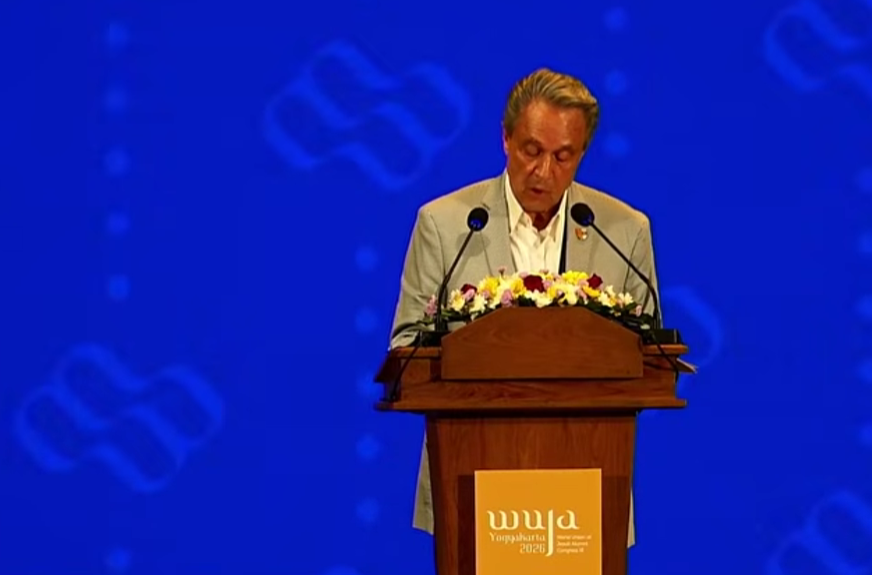
YOGYAKARTA, Indonesia – Identity as a Jesuit alumnus should not remain a fond memory of school days or merely a sense of belonging to one’s alma mater. Instead, it must become a compass that guides concrete action, service, and commitment to a shared mission. This was the central message delivered by Gabriel Calderón, President of the Union of Jesuit Alumni of Latin America and the Caribbean (UASIALAC), during his reflection entitled “Identity, a Compass to Action” on the second day of the XI World Union of Jesuit Alumni (WUJA XI) Congress at the Driyarkara Auditorium, Sanata Dharma University, Yogyakarta, on Thursday, July 30.
Addressing hundreds of Jesuit alumni delegates from around the world, Calderón invited participants to rediscover Jesuit alumni identity not as an institutional label but as a lifelong vocation expressed through service to others.
He argued that the greatest challenge facing Jesuit alumni today is not preserving their organizations but transforming the identity shaped by Jesuit education into a living force capable of making a meaningful impact on society. “Identity must become a compass that guides our actions. We are called not merely to remember the values we have received, but to bring them to life through service and mission,” he said.
From Identity to Mission
Calderón explained that over the past several months, UASIALAC had undertaken a process of listening and discernment on Jesuit alumni identity across the region. The findings revealed that an overwhelming majority of respondents continue to feel deeply connected to the values they received through Jesuit education.
Yet, he noted, this strong sense of identity has not always translated into active participation in alumni communities or sustained engagement in mission.
For that reason, he challenged Jesuit alumni to move beyond simply possessing an identity and begin living it through action.
Friendship among alumni, he said, is an invaluable gift, but it must evolve into genuine collaboration for the common good.
Becoming “Accomplices in the Mission”
One of the most compelling parts of Calderón’s reflection centered on the Spanish word complicidad—a term that literally means “complicity” but which he reinterpreted as a profound partnership rooted in trust and shared purpose.
He acknowledged that the word often carries negative connotations. However, he argued that it should be reclaimed to describe the deep bonds that unite people in a common mission.
According to Calderón, Jesuit alumni are called to become “accomplices in the mission”—people who trust one another, challenge one another, and willingly share responsibility in serving others.
“A collaborator may help us accomplish a task. A partner may share a project. But an accomplice shares something much deeper: trust, commitment, and a common purpose,” he said.
He therefore encouraged Jesuit alumni to see themselves not merely as representatives of their schools, universities, alumni associations, or countries, but as companions united in one Ignatian mission.
Renewing the Relationship with the Society of Jesus
Calderón also stressed the importance of renewing the relationship between Jesuit alumni and the Society of Jesus.
He said alumni should not simply wait for direction from the Jesuits but should confidently take initiative, drawing on the Ignatian spirituality they have received through their education.
Likewise, the Society of Jesus, he added, needs mature alumni who are capable of discernment, leadership, and shared responsibility in the Church’s mission.
That relationship, he emphasized, must be built on trust, closeness, and co-responsibility rather than dependence.
Keeping the Organization Alive
Reflecting on the future of WUJA, Calderón warned against allowing the organization to become active only in preparation for its four-yearly congresses.
“The congress should be the highest point of our common life—not the whole of it,” he said.
Instead, he called for a global alumni network that remains vibrant between congresses through international collaboration, leadership development, mentoring of younger generations, and concrete social initiatives.
“We do not want an organization that wakes up only to organize a congress and then goes back to sleep for another four years,” he remarked.
Three Steps Toward a Living Mission
To transform identity into mission, Calderón proposed three practical priorities.
The first is to connect by strengthening relationships across countries, institutions, professions, and generations so that experiences, resources, and opportunities can be shared.
The second is to accompany, ensuring that younger alumni are entrusted with real responsibilities while receiving authentic mentorship from experienced leaders.
The third is to mobilize, translating Ignatian values into concrete initiatives addressing today’s global challenges, including education, ethical leadership, reconciliation, social justice, and care for our common home.
Organizing the Good
Concluding his address, Calderón urged Jesuit alumni worldwide to make WUJA a movement capable of “organizing the good.”
He expressed the hope that the WUJA XI Congress in Yogyakarta would produce not only new friendships and common declarations but also deeper relationships of trust, shared responsibilities, collaborative projects, and lasting commitments across borders.
“We need companions to walk the journey,” he said. “But we need accomplices to keep the mission alive.”
Calderón’s reflection resonated strongly with the overall theme of the WUJA XI Congress, “United in Spirit, Leading with Purpose,” which calls Jesuit alumni around the world to renew their commitment as “men and women for and with others” by exercising leadership rooted in Ignatian spirituality and expressed through concrete service for the common good.