

YOGYAKARTA, Indonesia — Corruption is often measured in stolen money, illicit contracts, and political scandals. But for H.E. Claudia Lissette Escobar Mejía, Ambassador and Permanent Representative of Guatemala to the Organization of American States (OAS), corruption is far more devastating than financial loss. It destroys justice, undermines human dignity, and leaves society’s poorest and most vulnerable without protection.
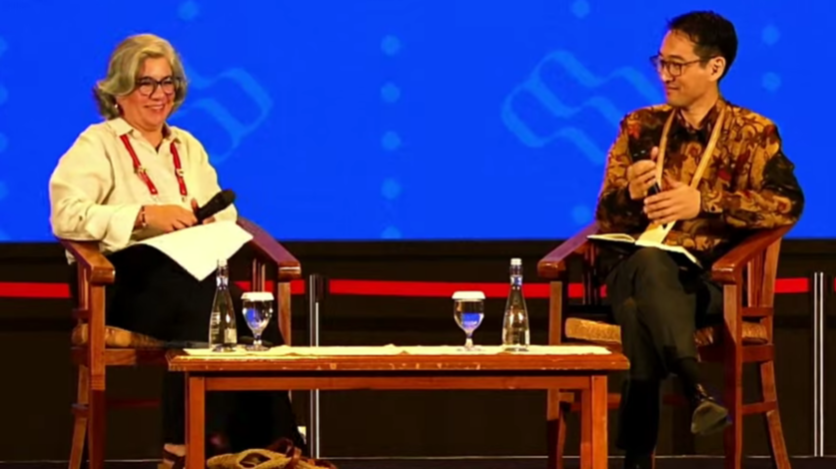
Delivering a keynote address during the fourth day of the 11th World Union of Jesuit Alumni (WUJA XI) on Saturday, August 1, 2026, at the Driyarkara Auditorium, Universitas Sanata Dharma, Yogyakarta, Escobar challenged hundreds of Jesuit alumni from around the world to see ethical leadership not as an abstract ideal but as a costly personal commitment. Speaking on the theme “Confronting Corruption with Integrity: Justice, Courage, and Human Dignity,” she argued that the fight against corruption ultimately begins not in courtrooms or government offices, but in the human conscience.
Moderated by Prof. Dr. Yuhki Tajima, Founding Director of Georgetown Asia Pacific, the session explored the relationship between Jesuit values and public leadership. Tajima opened the discussion by distinguishing leadership from authority, emphasizing that genuine leadership is not dependent on holding public office but on making difficult choices to do what is right, even when those choices come at great personal cost. He described Escobar as someone whose career embodied the Jesuit ideal of being “a woman for and with others,” pointing to her work as a judge and diplomat dedicated to democracy, justice, and the rule of law.
Escobar began not with legal theory but with a deeply personal reflection. Introducing herself as a mother of six, she explained that every major decision in her career had been guided by one question: What kind of country would her children inherit? Growing up during Guatemala’s decades-long civil war, which claimed more than 200,000 lives, she belonged to a generation of lawyers determined to rebuild public trust through an independent judiciary. For her, justice was never simply a legal profession; it was the foundation upon which peace and democracy could be built.
From that personal story, Escobar moved to a broader moral argument. Justice and the rule of law, she said, are not technical concepts reserved for judges and lawyers. They are the architecture of human dignity and the strongest protection available to the poor, the marginalized, and those without political influence. When courts are independent, citizens can rely on equal treatment before the law. When corruption infiltrates institutions, however, the first victims are always those with the least power.
Drawing on international human rights instruments and the United Nations Sustainable Development Goals, she stressed that peace, justice, and strong institutions are prerequisites for development, democracy, and the protection of fundamental rights. Corruption, therefore, is not merely an administrative failure but a profound moral offense against human dignity.
Quoting Transparency International’s definition of corruption as “the abuse of entrusted power for private gain,” Escobar argued that such a definition reveals corruption for what it truly is: a betrayal of public trust and of one’s own conscience. Although corruption is often discussed in economic terms—through bribery, fraud, embezzlement, or illicit enrichment—its consequences reach much further. It deprives hospitals of medicine, schools of classrooms, and communities of hope.
To illustrate the human cost of corruption, she recounted the collapse of a government housing complex in Venezuela following a major earthquake. Investigations later revealed that political expediency had overridden engineering standards, unsafe land had been approved for construction, and oversight had been abandoned in favor of electoral promises. When disaster struck, thousands of families paid with their lives for decisions rooted in corruption rather than public responsibility. “Corruption,” she said, “is not a victimless crime. It has names. It has faces.”
Yet, according to Escobar, corruption rarely begins with spectacular scandals. Instead, it starts with seemingly small ethical compromises—a favor granted, a blind eye turned, a personal interest placed above the common good. Over time, these individual choices grow into systems of impunity capable of consuming entire institutions.
She cautioned that education alone cannot prevent such failures. History, she observed, offers examples of highly educated political leaders who nevertheless embraced authoritarianism and corruption. Intellectual excellence, she argued, is insufficient unless it is accompanied by ethical formation rooted in service. Echoing the vision of Jesuit Superior General Father Pedro Arrupe, she said authentic leadership requires becoming “persons for others,” recognizing that public office is a trust rather than a privilege.
The most powerful part of her presentation came when she recounted her own experience as a judge in Guatemala.
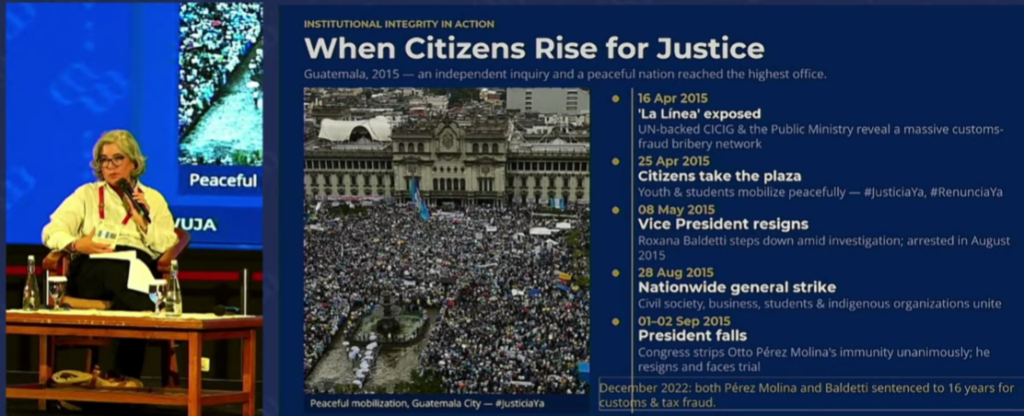
While serving on the Court of Appeals, Escobar was asked to rule on a case involving then Vice President Roxana Baldetti. During the proceedings, the Speaker of Congress allegedly attempted to bribe her in exchange for a favorable judicial decision. Unknown to him, Escobar recorded the conversation. Rather than accept the offer, she publicly denounced the attempt.
The decision fundamentally changed her life.
She received threats, international human rights bodies granted precautionary protection measures, and in January 2015 she and her family were forced into exile in the United States. Looking back, she described exile as a tsunami that swept away everything familiar. Yet it also opened unexpected opportunities, allowing her to continue promoting judicial independence as a fellow at Harvard University and later at Georgetown University.
Meanwhile, events in Guatemala unfolded dramatically. The bribery case moved forward, the politician involved was convicted, and widespread anti-corruption protests eventually forced both the vice president and the president to resign. Although later political developments revealed how corruption could reassert itself through new alliances seeking impunity, Escobar insisted that history also demonstrated the resilience of democratic institutions when courageous citizens refused to remain silent. She pointed to the election of President Bernardo Arévalo and Guatemala’s renewed commitment to strengthening judicial independence through international cooperation as signs that meaningful reform remains possible.
Throughout her address, Escobar repeatedly returned to a central conviction: corruption can be defeated, but only through ethical leadership.
Citing Harvard scholar Robert I. Rotberg and his book The Corruption Cure, she argued that countries overcome corruption not simply through stronger laws or international pressure, but through leaders who deliberately choose integrity, transparency, and accountability over personal enrichment. Such leaders protect independent courts, welcome oversight, and consistently demonstrate that corruption will have real consequences. Structural challenges matter, she acknowledged, but they do not determine a nation’s destiny.
That message resonated during the dialogue session that followed.
Asked how people can continue pursuing justice when judicial systems themselves become compromised, Escobar emphasized that no one should confront corruption alone. Moral courage, she said, grows through supportive relationships—with family members, trusted colleagues, professional communities, and spiritual mentors. Ethical leadership is sustained not only by personal conviction but also by communities that reinforce integrity during moments of crisis.
Reflecting on the source of her own courage, she rejected the idea that she considered herself exceptionally brave. Instead, she described courage as fidelity to conscience. Remembering the example of her mother, who dedicated her career to protecting abused women and children, she said she ultimately asked herself a simple question: What would I tell my children if I remained silent? That question, she explained, gave her the strength to expose corruption despite fear for her own safety and that of her family.
Responding to a question from an Indonesian Jesuit alumnus about promoting integrity beyond specifically Christian moral frameworks, Escobar stressed that the principles of judicial independence are universal. International standards such as the Bangalore Principles of Judicial Conduct, she noted, provide ethical guidance applicable across cultures and religions. Protecting judicial independence, she added, is not primarily about defending judges but about safeguarding the rights of ordinary citizens who depend on impartial courts for justice.
As her address drew to a close, Escobar returned to the audience gathered in Yogyakarta.
Jesuit education, she said, has formed generations of influential leaders around the world through discernment, cura personalis, and a commitment to justice. Yet formation alone is never enough. Conviction must mature into courage, and courage must ultimately be expressed through action—even when that action carries personal consequences.
For Jesuit alumni, she suggested, the true test of leadership is not whether they attain positions of influence, but whether they remain faithful to integrity when integrity demands sacrifice.